Wednesday, 21 July 2010

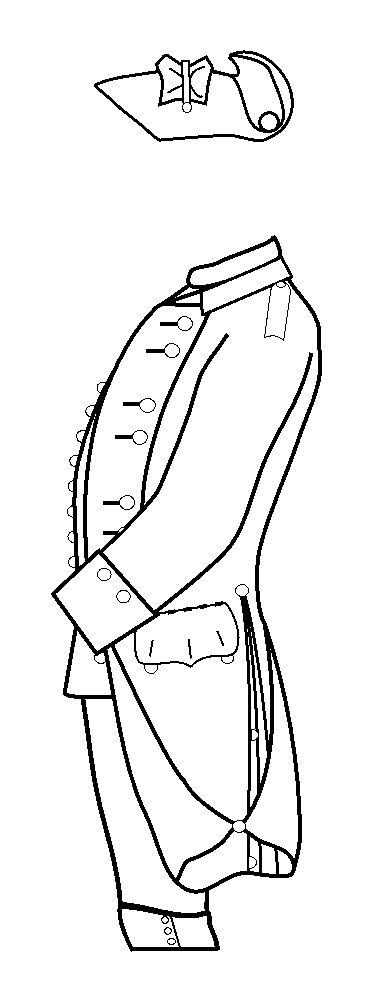
Hesse Kassel IR Prinz Carl, Musketeer 1762

First raised 1683. Organisation SYW: 2 battalions each with 4 musketeer companies: each battalion also had a grenadier company which together formed a grenadier battalion with the 2 grenadier companies of another regiment.

Chef: 1755- Prinz Carl von Hessen. Kommandeur 1760-1770 Oberst H. A. von Lossberg, General Major. 

Main actions in SYW: 1757 Hastenbeck 26.07.1757; 1758 Krefeld 23.06.1758; 1759 Bergen 13.04.1759, Minden 01.08.1759; 1761 Vellinghausen 15-16.07.1761.

Wednesday, 7 July 2010

New Poll: Is there a need for a separate website for the templates?

 In the image above the artist gets to grips with web design on a prototype 18th century computer... ;-)

Several people have suggested in the past that the blog is not a very good format for displaying and presenting the templates and I think there's some truth in that. With the linear format of the pages older templates disappear into the dim and dusty recesses of the blog. I have considered doing a supplementary website where they can be more accessibly and clearly presented. The problem is that at present I have too little time to do more templates as often as I'd like and making a website will eat up even more time I don't really have, so if I were to embark on creating a website even fewer new templates would be done in the near future. Hence the poll to gauge what sort of popularity a website would have to see if it would be worth the effort (although I make no promises that even if a website is overwhelmingly popular, it will happen soon or even at all!). But it will be helpful to get some idea...

UPDATE 16.07.2010: Thanks to everyone who commented and voted on the poll. I'm thinking about how to go ahead now and will report back when a decision is made!

Thursday, 3 June 2010

Saxon Feldjägerkorps Revisited

Thanks to John Cunningham I now have an illustration of a Saxon Feldjäger from W. Dittrich's Sächsische Uniformbilder (1620-1810). Dated 1735, it is very similar to the uniform described by Schirmer in Pengel & Hurt and which I illustrated below from the verbal account. Differences include no button lace on the cuffs and an aiguillette on the left shoulder rather than the usual right. The figure is shown dismounted so no detail of horse furniture is given. Dittrich's plates also include Feldjäger uniforms of 1765 but they are very different in cut and detail and show a distinct change in style of Saxon uniform after the Seven Years War.


A quick plug for John Cunningham's figures here; he has revived, markets and is expanding a number of classic 20mm wargames figure lines (Les Higgins' splendid ECW and Marlburians, for instance) and now has available the Wodensfeld 20mm SYW French. If you would like to know more about these or any of John's other 20mm ranges, please email him on: CunnJoh [at] aol [dot] com for details.

Thursday, 20 May 2010

Hesse Kassel Artilleryman (after Witzel)

This is the post-1761 regulations Prussian-style artillery uniform as depicted by Witzel (full book reference, see below). As with the other units it is highly likely that this uniform was late seeing service in the SYW.

Sunday, 16 May 2010

Map and plan resources using Gimp (and Photoshop)

Some useful map and plan Gimp brushes here: http://istarlome.deviantart.com/gallery/#brushes-and-vector-resources for those of you doing ImagiNations work. Many more Gimp brushes including some other map and plan-related material here: http://browse.deviantart.com/resources/applications/gimpbrushes/

If you're a Photoshop user you can find many brushes including map ones here too: http://browse.deviantart.com/resources/applications/psbrushes/

Note that many Photoshop brushes can also be used directly in versions of Gimp later than 2.4.

Gimp is a free program for image manipulation and creation that can be downloaded from here: http://www.gimp.org/downloads/ and information on the Gimp can be found here: http://www.gimp.org/ Many tutorials are also available from the Net.

Saturday, 15 May 2010

Hesse Kassel Foot Jägers - Variant 2

This version is based on the work of Rudolf Witzel, Hessen Kassels Regimenter in der Alliierten Armee 1762, 2007, which shows the army in its very Prussian-style uniforms after the 1761 regulations. Note, however, that there is evidence that just about the whole Hessian army were still in their previous uniforms at the end of the winter of 1761-2 (thank you to Christian Rogge for the information!) so this shows the new regulation uniform rather than how they actually appeared in the field until perhaps much later!

It seems more and more likely that various features of version 1 (see below) (e.g. the plume) may have been extrapolated from the American War of Independence uniform and not relate to the SYW period at all. Reliable information about the early SYW Hessian uniforms is not easy to find.

Thursday, 13 May 2010

Hesse Kassel Foot Jägers - Variant 1

During the SYW there were 2 companies of foot jägers, to which were added 2 companies of mounted jägers in 1759. They fought in many small and large actions during the war, most notably at Sandershausen against the French in 1758 where, from their position on the right wing of the Allied army, they caused many casualties in the French infantry.

As with all Hesse-Kassel uniforms there seems to be much disagreement about the details. This is based on the version given by Pengel and Hurt and the Heer und Tradition Plate 91.

Sunday, 2 May 2010

Hesse Kassel Artilleryman

Hesse-Kassel contributed a substantial force to the Allied army, including a fairly powerful artillery arm. The artillery were dressed in a sober uniform of blue and crimson/red. More to follow on the Hessians...

There seems to be considerable disagreement on the details of the Hessian uniforms of the SYW, at least in part because the uniforms do seem to have changed and evolved throughout the war. This is the version of Schirmer via Pengel and Hurt. I shall next post the version of Rudolf Witzel in  his recent book (2007) on the Hessian army of 1762. Kronoskaf's version, based on many sources, is different again.

Update 12.05.2010 - I'm currently working on various Hessen-Kassel uniforms but finding it difficult to find definitive information on the uniforms, as every secondary source seems to disagree on the details. I should shortly receive a copy of Rudolf Witzel's book on the HK army of 1762 (only parts of the book are viewable on Google Books) and I know that that book, useful though it will be in many ways, will only add to the confusion about uniform details. This is getting as bad as French SYW uniforms...

Thursday, 15 April 2010

NCO of the Saxon Feldjägerkorps

Apart from a verbal description of the uniform from Schirmer via Pengel and Hurt I can find nothing about this unit so if anyone can tell me more about its role in the SYW, I'd be grateful. Thanks.

Straw-coloured gloves were worn, and the carbine and sword had brass metalwork. Officers wore a sash but it is not known if they also wore a gorget or the customary green breeches. The style of the waistcoat is speculative, as is the style of the silver lace and that of the shabraque, although the colours are known.

Sunday, 11 April 2010

Saxon Henneberg Militia 1756; militiaman

The County of Henneberg was a detached part of Saxony well to the west in Franconia. As it was so isolated the inhabitants were expected to raise militia companies for their own defence; they were probably first raised in 1730 and disbanded in 1756.

Other ranks (in white with blue facings, shown here) had straw-coloured leatherwork with brass fittings and the usual musket and bayonet. They wore long grey stockings, not gaiters. Again, the Saxon-style lapelled waistcoat is speculative as the verbal description from Schirmer via Pengel and Hurt does not specify.

Saturday, 10 April 2010

Saxon Invalid or Garrison Company of Waldheim

The Saxon Invalid or Garrison Company of Waldheim, 176 strong in September 1756, was one of the garrison units captured at Pirna (see previous entry). Waldheim is an attractive small town with a castle and former monastery in central Saxony, rather knocked about in the 30 Years War, sacked and pillaged by the Prussians in 1761 and also the scene of some activity in the Napoleonic Wars, when it was occupied by the French and the bridge destroyed.

Leatherwork was straw coloured, and as well as musket and bayonet the troops carried a pallasch-style sword with a black scabbard. The uniquely Saxon lapelled-style of waistcoat is speculative, as the description of this uniform is a verbal one from Schirmer via Pengel and Hurt and does not specifically describe the pattern of waistcoat.

Thursday, 8 April 2010

Saxon Invalid or Garrison Troops 1756

Most European nations at this time employed semi-invalid trained or veteran soldiers as garrison troops, to avoid having to use regular soldiers to do the job, but putting vital fortresses in the hands of troops whose capabilities, morale and motivation were sometimes suspect could be problematic. The Saxons had 8 companies of such troops and this appears to be the main uniform worn by most of them. As well as a musket and bayonet they carried a sabre with brass metalwork and a brown leather scabbard.

Saxon garrison troop numbers for September 1756 were: 3 companies as garrison at Wittenberg, 354 men; 1 company as garrison at Waldheim [in a grey uniform which I shall depict next], 176 men; 1 company as garrison at Pleissenberg, 115 men; the garrison at Königstein, 195 men; and the garrison at Sonnenstein, 125 men. All these were gathered in to the fortified Camp at Pirna with its Sonnenstein Fortress and which also included the Königstein citadel, along with most of the Saxon army. Unfortunately, from the beginning the plan was botched as equipment, ammunition and food and fodder were in short supply and the Prussian hussars quickly prevented any sorties to acquire more food and fodder. The fortresses were also in a poor state and so the garrisons (who were weak in numbers and condition) were all gathered into the fortress of Königstein, with a newly-arrived Anhalt free company from Wittenberg stationed in Pirna town and Sonnenstein.The camp simply became a large prison camp for the Saxon forces and Frederick wisely kept them bottled up without any attempt to storm it, which would probably have been suicidal, given the difficulty of the terrain. The Saxon army, after an abortive breakout attempt, surrendered on the 16th October to avoid starving to death. The garrison of Königstein (which included the men from Sonnenstein) was the only unit exempted from the surrender and the fortress of Königstein was declared neutral for the duration of the war; the Saxon army's colours and standards were placed there and not taken as trophies of war, the only concession that Frederick made to the Saxons. The other garrison troops were forcibly enlisted in the Prussian army along with the rest of the Saxon units. The cavalry were distributed amongst the Prussian cavalry and the Saxon infantry formed into 10 new infantry regiments. Within months all but 3 of those infantry units had been disbanded because of desertions; many of the Saxon deserters joined the Austrians or the French to continue their war against Frederick, who seems to have had  a personal grudge against all things Saxon.

I am grateful to Stefan Schulz for translation work on Francke and Schuster's book of 1885 on the history of the Saxon army and for details from Markus von Salisch: "Treue Deserteure. Das kursächsische Militär und der Siebenjährige Krieg", Munich (Oldenbourg) 2009 - ISBN 978-3-486-58805-7.

Monday, 18 January 2010

More recent NBA flags up on the Kopf-Schlager ImagiNation Blog!

Many of my recent ImagiNation flags can be seen posted on the Kopf-Schlager ImagiNation blog at: http://cardinalhawkwood.blogspot.com/


:-)

Sunday, 3 January 2010

NBA Flags up on Herrschaden Blog

One of the flag projects that has kept me busy lately has now been posted on the Herrschaden blog: http://herrschaden.blogspot.com/ with interesting write ups by the Direktor. :-)

Thursday, 24 December 2009

Happy Xmas and New Year!

In the age old tradition of the NBA Blog, I wanted to wish everyone Happy Xmas and a Happy New Year, as well as to post the usual obscure sort-of-Xmas-related template of a genuine 18th century uniform for people to identify. :-)

See you all next year...

David.


Update: The uniform is that of Norwegian ski troops of 1765, as shown in a manuscript manual of that year by one Grüner; see the bottom 2 plates on this website: http://www.elverumske.no/esc_english/history.htm

Friday, 18 December 2009

Not quite SYW but...


My apologies for the long gaps between posting here but behind the scenes I've been busy with various flag projects, some paid; one project is British flags of the late 17th century and War of the Spanish Succession (snapshot of 2 such flags attached) for a friend. No prizes on offer but it will be fun to see if anyone recognises them. :-)

I do have plans to do more on this blog but shortage of time and energy are the enemy at the moment. I'll post more here as soon as I can; hopefully next will be more Saxon SYW heavy cavalry, a Saxon uhlan and some more hussars of various nations, as I'd like to squeeze more mileage out of my hussar template since it was a lot of effort to create it!

Thursday, 19 November 2009

ImagiNations Flags Just Completed...


I had a request for 2 ImagiNations flags based on Prussian infantry colours from Cardinal Hawkwood on the TMP forums so thought I'd post a JPEG of them here. The originals are in PDF vector format so much crisper than these but this gives some idea of them. I did unshaded, background shaded and fully shaded versions and it was the fully shaded versions that were chosen. I have to say I'm quite pleased with the flags! :-)

Update 4th December: See them in action at: http://passageoflines.50.forumer.com/viewtopic.php?f=64&t=704

Thanks, Cardinal Hawkwood! :-)

Monday, 16 November 2009

Dragoon of the Leib-Dragoner Regiment Kurfürstin von der Pfalz (Princess Elector)


From 1758, when it joined the Reichsarmee, the regiment had 5 squadrons of 2 companies each, with a total strength of about 800 men and horses.

I can find little record of the unit's service with the Reichsarmee; after joining in 1758 the next mention (in Pengel and Hurt) is in June 1760 when they were still at 5 squadron strength, with a suggested total of perhaps 500 men (at an average squadron strength of 100 for the entire cavalry of the Reichsarmee). The regiment does not appear to have been at Freiberg in 1762. If anyone knows more, please do let me know and from what source you have found the information.

There are 2 descriptions of the uniform, one from 1747 and one from 1777, but nothing directly from the SYW, unfortunately. The earlier one gives black-lined coats, the second red lined; the earlier also gives yellow shoulder knots, the latter black. No description of the horse furniture survives; Knötel shows the regiment with red shabraques laced yellow but we do not know what the source for this was so it is probably unreliable. I have chosen the colour scheme of the earlier uniform rather than the later one but it is possible that elements of the later uniform were already in use during the SYW. I have also used the colour scheme for the horse furniture shown by Knötel, for want of anything else.

Saturday, 31 October 2009

Map symbols in progress...


I'm still fiddling around with new map symbols now and again. Here are the prototypes of a Wasserschloss (based on one in Schleswig-Holstein) and a town hall, based on the famous one at Alsfeld in Hesse.

The great beauty of vector drawings (and these will be available as .svg drawings) is that they are clear and crisp at any size, small or large, unlike pixel-based bitmap illustrations, so the detail is not wasted. The jpeg shown here cannot and does not do justice to the crispness of the originals!

Monday, 19 October 2009

Grenadier of the Württemberg Leibgrenadiere à Cheval


First raised 1758. Theoretically 4 squadrons of 512 men total. More details to follow later...

Monday, 12 October 2009

British 18th century infantry colours - 4th Foot


I had a request for some AWI British colours so thought I'd keep things ticking over here by posting 2 versions (one shaded, above, one not, to the left) of what I've just done in a format that's usable by anyone who wants the finished version - this JPEG image will not be editable without significant deterioration of the image so it's not really one for ImagiNations people to play with, I'm afraid. What you see is what you get! ;-) (And frustratingly if I were to post it as a large non-lossy PNG file the crazy blog would convert it to JPEG.) It's quite suitable for SYW to AWI (or even up to the Revolutionary Wars of the 1790s) as the design barely changed throughout the mid-to-late 18th century. The top colour is the regimental colour and the bottom one the King's colour; every British battalion had one of each. You can scale the image for printing to whatever size you need. (The original flags were 6 feet 6 inches by 6 feet but it seems most wargamers like their flags oversized and for 25-28mm figures will often have British infantry flags like these 40mm across, for example.) The best format for high quality flag images is really PDF as they remain vector files but they can't be posted for viewing on the blog anyway. If anyone wants the high-quality PDF version, let me have an email address in the comments and I'll send it to you.

Also, if anyone wants to commission me to do flags for them (18th-19th century particularly) I'm open to suggestions/ideas; being paid to do them is especially appealing but if it's not too onerous a task I'm also still open to the possibility of doing some freebies. :-)

Tuesday, 6 October 2009

Long time no post...


It's been quite some time since I last posted a template, sadly. Real Life has been the bugbear, in part, plus I've been commissioned to do some flags for an ImagiNation. It's been a very enjoyable project but it's a pity there aren't 72 hours in a day! Hopefully images of some of those will be appearing on the appropriate blog but I'm sworn to secrecy until that happens, upon pain of lifelong conscription into a very rough and tough regiment...

I've enjoyed developing my flag drawing skills. I'm currently working on possible prototypes of some British Napoleonic colours; snapshot attached of roughs of variants of the colours of the 33rd Foot 1815. The final versions of these flags are produced as high quality PDF files, with the advantages of vector images that they are highly detailed and crisp at almost any magnification.

When doing some hunting on the 'Net for information on British 18th and 19th century flags I came across this very inspiring site: http://www.dupagemilitaryflag.com/743917.html with lots of fascinating detail on British flags, and also on how so many modern illustrations and reproductions get the proportions of the flags and their details badly wrong. It's mostly because people misread amd misuse what is still one of the prime sources of information, a book produced in a limited edition in 1893, Samuel Milne Milne's "Standards and Colours of the [British] Army 1661-1881". (The DuPage military flag site also has a very interesting article on AWI Hessian flags, available as a PDF file, and photographs of some of the splendid and beautiful reproduction flags they make for museums, re-enactors and anyone who wants a high-quality, well-researched historical military flag or colour.)

Sunday, 9 August 2009

Fusilier of the Schaumburg-Lippe-Bückeburg Infantry Regiment

Raised 1751. A regiment of 8 companies c.820 men. Chef: Graf Wilhelm von Schaumburg-Lippe.

Schaumburg-Lippe was the smallest allied state but contributed quite heavily for its size, providing very good artillery, a miner company, an infantry regiment and a mounted carabinier company.

The infantry regiment fought entirely in the western theatre against the French and was at the siege of Minden 1758, the battle of Krefeld 1758, the battle of Lutterberg 1758, the battle of Minden 1759 and the battle of Vellinghausen 1761, as well as other actions. According to Mollo, the unit eventually became entirely an artillery guard unit.

Most depictions seem to rely on a
Knötel plate showing Schaumburg-Lippe units in 1765, later than the SYW; Mollo's picture of a soldier of this unit differs in showing pure white pompom and bobs, a black stock, buttons on the cuffs and no buttons on the left side of the coat.

Belts were white, cartridge box black leather, scabbards brown, sword hilt brass with brass fittings on the scabbard, shoes black leather.

Sunday, 2 August 2009

Trooper of Saxon Karabiniergarde (Variant 2)

This is based on the work of Johannes Eichhorn, as discussed in my previous posting; again, many thanks to Harald Howe for the information.

Differences from Friedrich's interpretation as shown in my previous template include no shoulder strap, Swedish cuffs with 3 buttons in the standard configuration, the white aiguillette and the different design of the pistol holster cover, with only one line of red lace and more pointed at the bottom.

I'll post more detailed information on the unit and its history later. In short, they were in Poland during the Pirna debacle and so were spared the forcible enlistment in the Prussian army suffered by so much of the Saxon army. They then fought with the Austrians from 1757 to the end of the war in 1763, and were present at Kolin, Moys, Torgau and Freiberg, amongst other actions.

Saturday, 1 August 2009

Trooper of Saxon Karabiniergarde (Variant 1)

It has been quite a saga finding information on the Saxon Karabiniergarde and there will be at least 2 variants of this uniform, as the sources I have conflict. This is one of the variants suggested by Wolfgang Friedrich; the other variant will be based on the work of Johannes Eichhorn of Großenhain in Saxony, who did a great deal of research on the Saxon Army from the 1920s to the 1940s, not auspicious times for doing such work, and sadly he now seems to be almost forgotten. Friedrich mentions Eichhorn in his references but little of Eichhorn's work was ever published. I am very grateful to Harald Howe for bringing Johannes Eichhorn and his work to my attention. I have a particular fondness for the Saxon Army of the mid-18th century and I am pleased to be able to bring the valuable work of a nearly forgotten researcher on that army to the attention of those using this blog.

Unit details etc. to be completed later...