








Sunday, 1 May 2011
WSS Cuirassier in tricorne

Friday, 29 April 2011
Early 18th Century European Cuirassier


The coloured version represents the Bavarian Horse Regiment Salburg Widel at the time of the War of the Spanish Succession.
This template is an adaptation of a simpler one I did as a commission for Moshe some time ago.
Wednesday, 13 April 2011
Recently finished design for Golconda
Here's a snapshot of a commission I've recently finished for Golconda; see: http://golcondarising.blogspot.com/ It's an excellent and fascinating blog on wargaming all things Indian in the 18th century.
I think the exotic talwar came out pretty well... :-)

Friday, 1 April 2011
Typical British Sailor c.1750


This is the typical Sunday-best dress of a British sailor of around 1750. In the days before any official uniform for ordinary sailors a sort of uniform was produced by each ship having clothing issued by the ship's purser - so-called "purser's slops". The blue jacket without tails has the classic three-button opening cuff. The mustard coloured waistcoat would often have the addition of gold or silver lace if the sailor had won some prize money and if that were so his black leather buckled shoes would also possibly acquire silver or gilt buckles. Breeches and stockings were often worn as an alternative to the loose trousers. The small flat tricorne was typical working class wear and it was sometimes aped by young men of the upper classes. When out walking in the town a sailor would often carry a cudgel or cudgel-like walking stick.
Wednesday, 30 March 2011
Not Quite SYW But - Napoleonic British Sailor in his Sunday best
Another commission from some time ago by Moshe, to whom again thanks for permission to upload it here, this is a template of the typical "full dress" Sunday best of a British Napoleonic sailor; there was no prescribed uniform until well into the 19th century but British sailors did tend to wear rather similar clothes, partly because many of them were "slop", acquired from the ship's purser.


I hope to get round to a template for a genuine 18th century sailor before too long but in the meantime someone may find a use for this.
Sunday, 27 March 2011
Royal Navy Lieutenant, Full Dress


Wednesday, 23 February 2011
More elements for ImagiNations mapping

As with the uniform templates (see the copyright notice on the left of this page), I'm offering them free to use but retain the copyright and they must not be sold or used in any profit-making enterprise without my permission
If anyone would like the SVG file, please leave a message in the comments with your (disguised) email address and I'll email it to you.
Friday, 24 December 2010
Happy Christmas and New Year to All - and another Regiment Nikolaus
Just wanted to wish everyone a happy holiday and New Year, and to thank everyone for visiting the blog, commenting and for using the templates in various ways. I'd also like to thank those who have commissioned flags and other items from me.

Saturday, 11 December 2010
Royal Navy Midshipman, full dress


Thanks to Moshe again, as this was another of the templates I designed for him.
Wednesday, 17 November 2010
Royal Navy Captain, undress uniform


This is the undress uniform of a captain - dress uniform did not have the lapels but had more gold lace.
This was part of a commission of templates of 18th century naval uniform by Moshe, who kindly allowed me to present this for general use.
Thursday, 28 October 2010
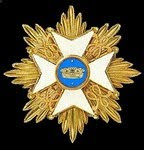
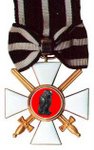
Order of the Golden Lion of Katzenstein

Saturday, 16 October 2010
Trooper, Saxon Garde du Corps 1756


According to Johannes Eichhorn and Eberhard Boltze (details differ slightly). Text to follow sometime...
Wednesday, 13 October 2010
French infantry officer in summer campaign dress, North America


Monday, 4 October 2010
Fusilier, Summer Dress, Compagnies Franches de la Marine, Canada 1750s


In bonnet de police, regimental waistcoat or veste and Indian leggings, this is a fusilier of the colonial infantry dressed for summer campaigning in Canada.
More text to follow...
Friday, 1 October 2010


Wednesday, 29 September 2010
Generic WSS Cavalryman


Just a quick item - with more work it could no doubt be improved but this might be of some use to the WSS enthusiasts. When I get chance I'll do a few WSS infantry templates too.
Tuesday, 28 September 2010
Coming soon - French infantry in summer campaign dress, North America
In North America the French infantry often fought in the summer in their long-sleeved waistcoats without the heavy justaucorps. That will be the next uniform type I'll depict, with a couple of variants of other ranks' uniform and an officer in gold-laced waistcoat and gorget.
Monday, 27 September 2010
Private, New Jersey "Blues", North America 1755-1763


This website: http://www.nj.gov/military/museum/frenchindian.html suggests they had a fairly rough war: "Indian raids along the colony’s northwest border in the summer of 1755 prompted the raising of a thousand man regiment of “Jersey Blues”, as well as a force to garrison forts along the Delaware. The Blues saw considerable combat. One detachment of the regiment was captured at Oswego in 1756 and another wiped out in a fight at Sabbath Day Point on Lake George in 1757. Another 300 were surrendered to the French at Fort William Henry in 1757 and some of these men were massacred by the Indians."
Friday, 17 September 2010
British Light Infantrymen, North America 1759


Light troops were much in demand in North America and "the most active resolute men" from the regular line regiments were selected to form a body of Light Infantry. Generals Amherst and Wolfe ordered their light infantrymen to put the sleeves of their coats on their waistcoats, add wings like those of grenadiers but larger and to extend down the sleeve, to have no lace but to keep the lapels, and to add two extra pockets of leather for ball and flints. They were to carry a knapsack "as the Indians carry their pack", that is, very high between the shoulders, have a cartouche box under the arm on the left side suspended from a leather strap, carry a canteen covered with cloth under the knapsack and have a tomahawk in a rough case with a button in a leather sling at the side. Fusil, bayonet and powder horn were also carried. The leggings had leather straps under the shoes and the tricorn hat was cut down into a cap and flaps added so that it could be fastened under the chin for warmth. The result was not pretty and must have given many of the more traditional officers and NCOs apoplexies but it was practical.
Initially the light infantry fought with the rangers on guerilla operations but in 1759 they led the army up the Heights of Abraham to Quebec. In 1760 they were returned to their regiments but the experiment was not forgotten and in 1770 line infantry regiments were given light infantry companies to make 10 companies per battalion (including 8 battalion or "hatmen" companies and a grenadier company). (Already in 1755 some regiments had been experimenting with "picquet" companies which were also forerunners of the light company and which were copied from the French.)
Friday, 10 September 2010
British 80th Foot, North America 1758


Although the ranger units were useful and effective in their own way, it was felt that regular units of light infantry were needed in North America. In 1757-8 Colonel Thomas Gage raised a unit of 500 light infantry at his own expense. They proved useful throughout the war but especially in the suppression of Pontiac's Rebellion in 1763-4, when, at the end of the SYW, a number of tribes (especially in the Great Lakes region) rose up against the British as a result of dissatisfaction with the British policy of treating the Indians as a conquered people, in contrast to the previous French policy of conciliation. The regiment was disbanded in 1764.
Their uniform was unusually drab, as it consisted of a short brown jacket with black painted or japanned pewter buttons, brick red waistcoat and breeches, and gaiters of varying colours, often brown, grey or blue-grey. Many men had shortened muskets, some with browned barrels. The authorities clearly had problems accepting so unorthodox a uniform, as by the end of the war the unit had a new uniform of a red jacket faced orange. Headgear was a jockey cap, usually cut down in various ways from the cocked hat and with flaps that could be lowered to protect the head in bad weather.
Monday, 6 September 2010
British Ranger Officer 1750s


Sunday, 22 August 2010
British Rangers 1750s


Sunday, 15 August 2010
Some historical flag work in progress...


Tuesday, 10 August 2010
Bavarian "Knecht" or Driver, on foot with gaiters

 Here's one of the essential, if unsung, characters of any army, a driver of the train. Mounted drivers wore long cavalry boots and the pack horses had red saddle cloths with the Bavarian arms in the corner. Each driver carried a short curved sword (rather like the grenadier sabre) attached to a white leather waistbelt, probably with a brown leather scabbard and brass sword furniture. Breeches were buff leather. The red stock was probably more typical of the early period - by the later SYW red stocks were kept for parades and were being phased out in favour of black.
Wednesday, 21 July 2010
Hesse Kassel IR Prinz Carl, Musketeer 1762

 First raised 1683. Organisation SYW: 2 battalions each with 4 musketeer companies: each battalion also had a grenadier company which together formed a grenadier battalion with the 2 grenadier companies of another regiment.
Chef: 1755- Prinz Carl von Hessen. Kommandeur 1760-1770 Oberst H. A. von Lossberg, General Major.
Main actions in SYW: 1757 Hastenbeck 26.07.1757; 1758 Krefeld 23.06.1758; 1759 Bergen 13.04.1759, Minden 01.08.1759; 1761 Vellinghausen 15-16.07.1761.
Subscribe to:
Posts (Atom)


