I have been asked in the comments by Der Alte Fritz for a speculative Leibfahne to go with this flag from the Triomphes Louis XV. So, here are two! I rather enjoy the chance to go all ImagiNations... ;-)


Being a uniform and flag design service to wargamers and to the imaginary crowned heads of 17th and 18th Century Europe, especially of the Seven Years War period - now By Appointment to the Court of Saxe-Bearstein! (But please note that the uniforms and flags presented here are not fictional - they are genuine 17th and 18th Century uniforms and flags that are as authentic as I can make them from my sources.)







As I have not been able to post anything for two weeks and as it is my 68th birthday today, I thought I had better post something to keep things ticking over here.
Luckily I have a little something that does not require much text. (I have a big backlog of flags waiting for their texts to be written.)
This is my speculative version of the Ordinairfahne of Hungarian regiments raised 1741-2. All we know is that the base colour was red. No other design details are known but it is highly likely that the flags followed what we think of as the classic Austrian flag design of the reign of Maria Theresa.
S. Summerfield in his Austrian Infantry of the Seven Years War (2nd Edition) lists the following six Hungarian regiments as having been raised in 1741: IR2 Erzherzog Karl; IR31 Haller; IR32 Forgách; IR33 Nicolaus Esterházy; IR37 Josef Esterházy; and IR52 Bethlen. So any (or all) of these could carry this red flag in the WAS.
I must also finish and post the 1741 version of the Leibfahne; I have not yet been able to complete the Madonna figure on the flag to my satisfaction...

Again from the Triomphes of Louis XV, here is another of the flags of Charles VI as carried by the army of Maria Theresa. Like the others I have depicted it was captured by the French army and so we luckily have an illustration of it so we can recreate it.
I suspect from the heraldry that it may be of an Austrian Italian regiment but I would be happy to be corrected if someone knows better.
I am near the end of the Charles VI flags as depicted in the Triomphes, with only two more to recreate. Both are like this one, with complex heraldry, so as this one seems to have taken me forever to finish I have no idea when I shall be able to create them! As, however, I have seen very few of my previous Charles VI flags in action (a broad hint!) I see no urgency anyway... ;-)

For more on this regiment, see my previous post of the later flags of IR49 (below). I repeat below some of the information I posted there showing where this flag was probably carried by the regiment during the Seven Years War, including at the battle of Zorndorf.
The ground colour of the flags was the same for both this unusual flag and the later flags carried by the fusilier regiment.
Even before conversion to an ordinary infantry regiment, the unit had
been used in various ways. After the defeat at Kolin in 1757 its First
Battalion was sent to defend the important magazine at Zittau. On July
23rd 150 men of the unit were captured in the burning city with their
commander, Colonel von Diericke.
In 1758 it joined the King's
Army and was used in the siege and capture of Schweidnitz in April and
then at the unsuccessful siege of Olmütz. On August 25th at Zorndorf it
performed heroically and attacked two enemy batteries, capturing two
howitzers and six powder wagons. (Duffy, Army of Frederick the Great,
1st Edition (henceforth AFG1) shows at least 35% casualties in both
battalions.) It was then with the Pomeranian Corps under Dohna,
observing the Russians while the King moved away. On November 26th it
officially became a fusilier regiment and Major General von Diericke
became its chef.
The format of a blog is not helpful for finding previous posts and I have often been asked about creating flags that are in fact already on the blog. I've begun work on adding a list of all the other miscellaneous flags on my blog to the lists of French and Prussian flags which can be found in the top left of the side column on the blog. It is work in progress as there are many flags to list; so far, it lists Spanish infantry flags and Austrian early War of the Austrian Succession flags. Eventually it will list every flag on the blog that is not French or Prussian!
I shall also be listing flags which I have created already but are waiting for their text to be written before I post them. People who are desperately in need of those flags can then send me a message asking me to email them the flag(s) they need.
Most of the French cavalry standards are blue or red with gold embroidery so it is refreshing to find a yellow standard with silver; this is also an interesting unit for having served in the '45 on the Jacobite side. Many wargamers depict this unit, whose uniform is also an attractive one. The flag is a slight cheat, as we do not know the emblem on the reverse of the standard, so it is given the usual sun emblem and motto.
Raised first 1691 as Roi d'Angleterre by James II from Jacobite exiles in France. It fought in the battle of Landen in 1693. In 1698 it was incorporated in the French army.
Standard carried from 1740-1762.


Originally of one battalion. Ranked 108th in 1753 but 110th in 1759.
First raised by the Prince of Nassau-Saarbrück 1st November 1745. The Prince had asked for the commission on behalf of his son Louis who was still too young and obtained a brevet the 4th February 1746 to command the regiment until his son was of age.


Disclaimer: As Kronoskaf points out, we have no information on the flags carried by this unit, so these flags are entirely speculative and versions can be found floating about on the Internet; the one with the cipher RK has been used by many wargamers but I have also provided a possibly more plausible version with the eagle represented on both sides of the regimental flag.


Kurmainz was created from drafts of men from at least 2 (and possibly 3) of the Mainz Infantry Regiments for the duration of the war. It was a strong regiment, of 4 battalions with 2 grenadier companies and 8 3-pounder guns. As a single contingent unit it was one of the best of the Reichsarmee units; Soubise in 1757 rated it as "good".
Cogswell in Zweybrücken In Command gives various tables listing the Kurmainz Regiment, which suggest that only 3 of the 4 battalions were in the field. In May 1758 the 4 battalions had a nominal strength of 2524 but an actual strength of 2260. From the end of March to the 19th April only 3 battalions are listed for Mainz and so it is for the rest of the campaign year of 1758. The 2 grenadier companies had around 200 men in total.
The regiment was lucky to avoid Rossbach in November 1757, as it was on detached duty on the Saale River. Kronoskaf says that as its original composition was diluted with raw recruits so the unit quality deteriorated and its performance was consequently erratic.
In 1758 the regiment served with the Reichsarmee in Bohermia and then Saxony; one battalion was in garrison in Erfurt.
In 1759 the regiment ran away with the rest of the Reichsarmee infantry at the battle of Zinna (or 1st Torgau) on Septemebr 8th; the only Reichsarmee unit to behave well that day was the consistently excellent battalion of Hessen-Darmstadt. Mainz was at Korbitz on September 21st and Maxen on November 20th, at neither of which does it seem to have performed any important duty.
In 1760 the regiment was at the messy and inconclusive combat of Strehla on August 20th. Later it participated in the defence of Dresden.
In 1761 it was in Saxony. Its moment of glory was at Freiberg on October 29th 1762; as part of the left flank division of Mayern it helped delay the Prussian attack by Seydlitz and Kleist for a considerable time (see Duffy, By Force Of Arms).
The regiment was disbanded in 1763.
This was the uniform in 1756:

And here are the last flags of the ex-Saxon regiments. I'll be taking a break from Prussian flags for a while now!
Formerly Saxon Regiment Prinz Maximilian Infantry, after the surrender at Pirna in October 1756 this regiment became Prussian IR59, and was made the garrison of Wittenberg.
Its commander from November 1756 to 1st August 1757 was nominally Prince Friedrich Wilhelm von Preussen but the actual commander was Lieutenant-Colonel von Plotho.
From April to June 1757 the regiment was with the Prussian army which invaded Bohemia and was then made the garrison of Leitmeritz. On August 1st, after many desertions, the regiment was disbanded at Pirna and the surviving men distributed amongst other Prussian regiments.
[Again the short account is taken from details in Kronoskaf.]
Once again here are two versions of the flags, the ones below with the new improved eagle.


And this was the uniform in 1756:

The penultimate ex-Saxon Prussian regiment flags!
Formerly Saxon Regiment Prinz Clemens Infantry, after the surrender at Pirna in October 1756 this regiment became Prussian IR58, and was made the garrison of Halberstadt.
Its commander was Major-General Count E. B. von Flemming, January 1757 to October 1757.
Having had many desertions in 1757 the regiment was
disbanded in October that year and the surviving troops absorbed into
the Pomeranian Provincial troops at Stettin.
[Again the short account is taken from details in Kronoskaf.]
Once again here are two versions of the flags, the ones below with the new improved eagle.


Formerly Saxon Regiment Prinz Xaver Infantry, after the surrender at Pirna in October 1756 this regiment became Prussian IR57, and was made the garrisons of Krossen and Kotbus.
Its commander was Major-General Karl Duke of Braunschweig-Bevern (aka Jung Bevern).
On March 28th 1757 the 2nd battalion threw off its new forced allegiance and escaped to Poland, followed by the 1st battalion on the 30th March. (Presumably this involved the process described in Duffy Army of Frederick the Great which I recounted in my previous post about IRs 55 and 56: "Over the course of the following months the Saxon troops defected by
entire battalions at a time. "Most of the battalions in question, after
they had chased their commanders away or shot them, withdrew with full
military formalities. They took with them their bread and ammunition
carts, their regimental chests and all the other items of their baggage,
and they either marched to Poland or broke through to the French".
The regiment was reraised with new men but on November 12th the new 1st battalion surrendered at Schweidnitz and the 2nd battalion was lost on the retreat from Breslau. The regiment was not raised again.
[Again the short account is taken from details in Kronoskaf.]
Once again here are two versions of the flags, the ones below with the new improved eagle.


Formerly Saxon Regiment Prinz Gotha Infantry, after the surrender at Pirna in October 1756 this regiment became Prussian IR54 stationed in Magdeburg.
Its commander was Major-General W. von Saldern to December 1758 then Baron E. F. von Plotho to February 1763.
Once again here are two versions of the flags, the ones below with the new improved eagle.


The regiment seems to have remained as the garrison of Magdeburg for the whole of the Seven Years War. By the end of 1757 it was one of the very few remaining ex-Saxon regiments in the Prussian army. It was disbanded on February 16th 1763 and the men were used to build up Prussian IR 33 Fouqué, which had been captured at Landeshut in 1760.
[Again the short account is taken from Kronoskaf.]
And this was the uniform in 1756:

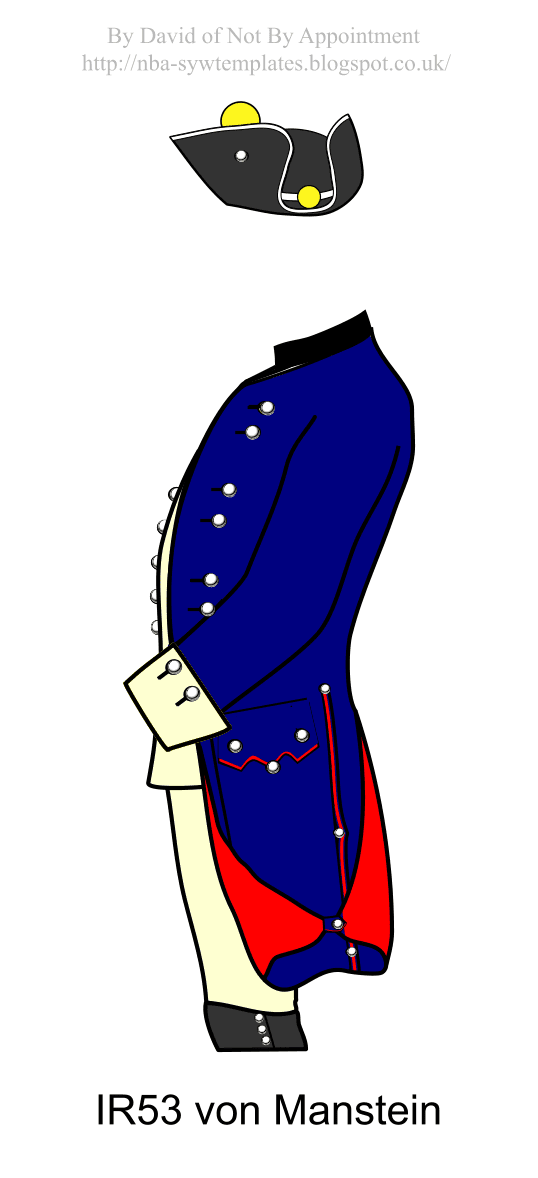
Formerly Saxon Regiment Minckwitz Infantry, after the surrender at Pirna in October 1756 this regiment became Prussian IR53 stationed in Frankfurt an der Oder.
Its commander was Major-General C. H. von Manstein to September 1757.
Here are two versions of the flags, the one below with an improved detailed eagle. At the size most people will print these out I suppose no-one will notice, except me. I shall continue to produce versions with the old unimproved flag for consistency with my "back catalogue" but will probably/possibly produce alternative versions with the new improved eagle as well.


The 2nd battalion took part in the invasion of Bohemia in April 1757 and on May 6th was taken prisoner at Brandeis. The 1st battalion went to Stettin and was absorbed into the Pomeranian Provincial regiments in September of that year.
[Again the short account is taken from Kronoskaf.]
And this was the uniform in 1756:
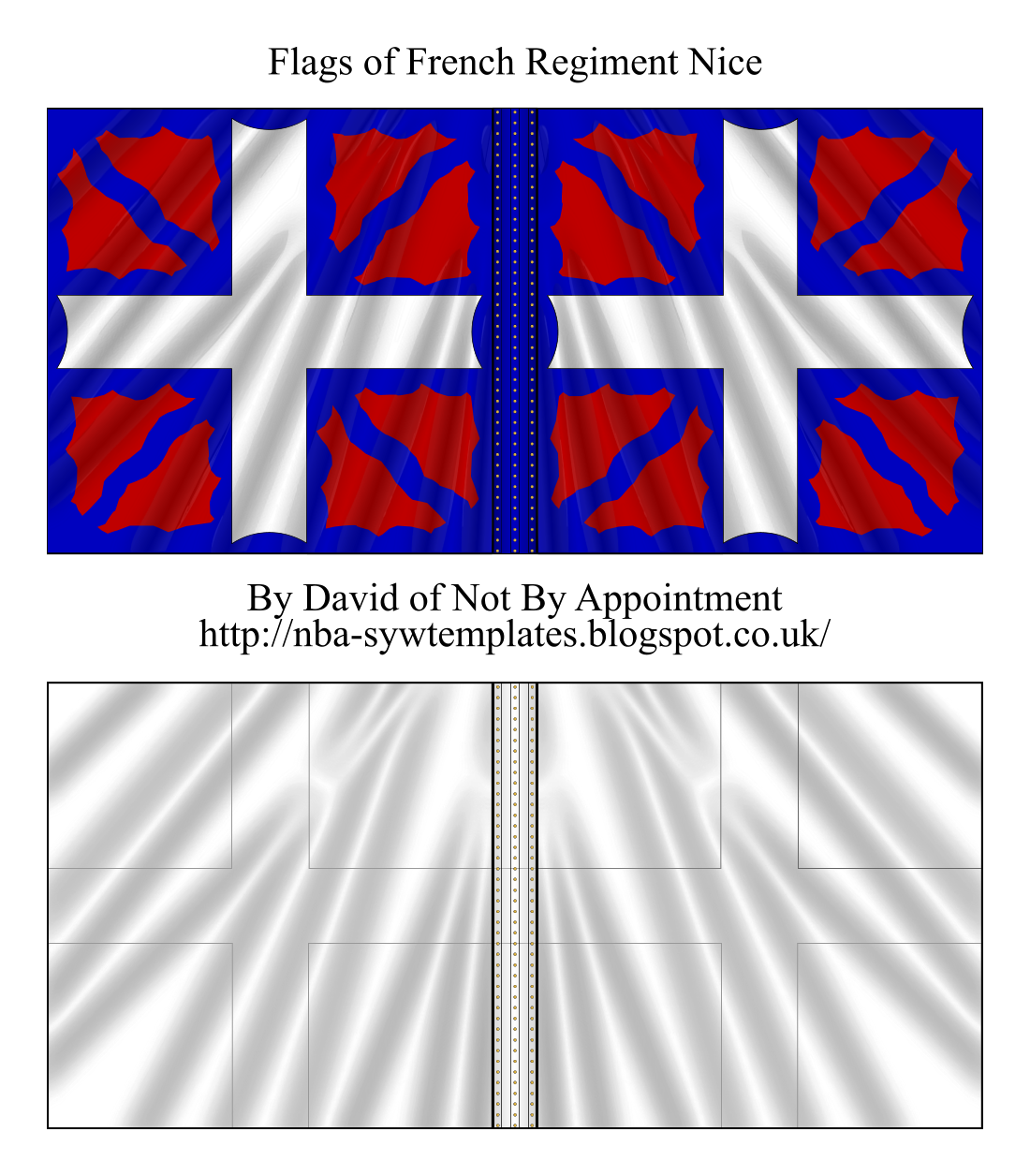
This was a regiment with an interesting flag but which did not do much in the Seven Years War, although it had a strong combat record in the late 17th century and in the War of the Spanish Succession.
First raised 1678 by the Marquis de Saint-Laurent from sergeants and soldiers of Savoyen Ducal regiments, of Saluces, of Savoy, of Chablais and Geneva, reformed this year.
The flags were the same from 1678-1762.
1690 Battle of Fleurus (July 1st)
1691: Siege of Mons
1692: Siege of Namur; battle of Steenkirk (August 3rd)
1693: Battle of Neerwinden (July 29th); siege of Charleroi
1695: Defence of Namur. Served on the Meuse and Moselle until the peace
1702: Army of Germany
1703: Taking of Treves and Traërbach,; sieges of Brisach and Landau; battle of Speyerbach (November 15th)
1704: Hochstedt [Blenheim] (August 13th)
1705: Army of Flanders
1706: Ramillies (May 23rd)
1708: Oudenaarde (July 11th)
1709: Defence of Mons
1710: Defence of Aire; Flanders until the peace
1733: Army of Germany; siege of Kehl
1734: Siege of Philippsburg (June 2nd - July 18th)
1741: Army of Bohemia; taking of Prague
1742: Combat of Sahay; defence and retreat from Prague
1743: Dettingen (June 27th)
1744: Army of the Lower Rhine; siege of Fribourg
1746: Army of Flanders; taking of Mons and Charleroi; battle of Rocoux (October 11th)
1747: Lawfeld (July 2nd)
1748: Siege of Maestricht
1755: Camp of Valencia
1756: Menorca Expedition
1757: Defence of the coasts of Brittany
1761: Defence of Belle-Isle
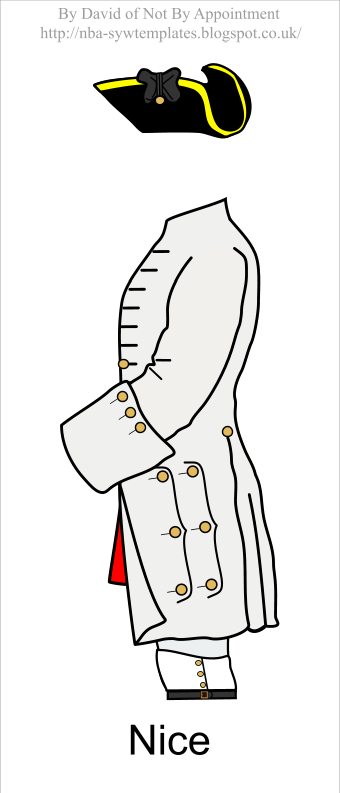
10th December 1762 the two battalions of the Nice regiment were incorporated into the Lyonnois regiment.
And this was the uniform in 1756:
Formerly Saxon Regiment Garde zu Fuss, after the surrender at Pirna in October 1756 the regiment became Prussian IR52 in Magdeburg.
Its first commander was B. S. von Blanckensee followed by Major-General J. F. von Oldenburg from February to July 1757.


Formerly Saxon Regiment Graf Brühl, after the surrender at Pirna in October 1756 this regiment became Prussian IR51 and was stationed in Torgau as garrison there.
Its commander was Major-General Baron von Wylich und Diersfort.


As something of a completist, and also because I feel the flags are actually rather attractive, I have decided to do the rest of the ex-Saxon regiments "borrowed" only temporarily by Frederick. Here is IR50, formerly Saxon Regiment Rochow Fusiliers.
From October 15th 1756 to July 30th 1757 it was commanded by Major-General L. F. L. von Wietersheim.

IR 50 was made the garrison of Halle in October 1756. In 1757 it accompanied Frederick's army for the invasion of Bohemia. On 30th July 1757 the regiment was disbanded after a large number of desertions and the remaining men were drafted into Prussian infantry regiments 7, 29, 35, 36 and 41.
And this was the uniform in 1756:

I was recently asked to do the flags of these two units so am posting them here in case there is anyone else keen to respresent them on the tabletop!
When Frederick finally forced the surrender of almost the entire Saxon army near Pirna on the 17th October 1756, "he announced that he intended to incorporate the Saxon regiments as intact units into the Prussian army". "The Saxon troopers were scattered among the Prussian horse but altogether ten regiments of Saxon infantry were taken over entire and shared among the generals .... Frederick had certainly counted on some individual desertions from the ex-Saxon units, but over the course of the following months the Saxon troops defected by entire battalions at a time. "Most of the battalions in question, after they had chased their commanders away or shot them, withdrew with full military formalities. They took with them their bread and ammunition carts, their regimental chests and all the other items of their baggage, and they either marched to Poland or broke through to the French". By the end of 1757 Frederick was left with just three regiments of infantry and one grenadier battalion, and even these were mostly composed of recruits who had been raised individually in Saxony.
Frederick would have done much better to split the Saxons up and incorporate them among his reliable old regiments, as Winterfeldt had suggested. It is difficult to understand why Frederick chose the other course. Perhaps he believed, like Prince Moritz of Anhalt-Dessau, that the Saxons would be eager to fight under a Protestant king or perhaps he was blinded by his inveterate hatred of all things Saxon... This episode remains among his worst miscalculations as a man-manager..." Duffy, The Army of Fredrick the Great.
IR55 (the former Saxon Fürst Lubomirsky Infantry ) seems to have been the only ex-Saxon regiment which saw active service in the Seven Years War. At first under the command of Major-General Baron C. von Hauss, it was commanded by L. P. von Roebel from December 1760 to 1763. At first as garrison at Halle, the regiment fought in the battle of Kunersdorf on 12th August 1759. As part of Finck's command, it suffered heavy losses; Duffy, Army of Frederick The Great 1st Edition shows around 40% casualties. One battalion of the regiment was part of a small isolated force under Major-General Dierecke at Meissen which was overwhelmed and captured by a much larger Austrian force on 4th December 1759. The three battalions of which it was part were isolated on the right bank of the Elbe and other Prussian troops were unable to help them. The regiment served in 1760 in Saxony and one battalion fought at Strehla on 20th August. It was again in Saxony in 1762 and one battalion took part in the surprise attack on Doebeln on May 12th. It was then in Bohemia with Seydlitz, fought at Teplitz on August 2nd and was part of the reserve at Freiberg on October 29th. (Most of the operational information from Kronoskaf.)
Duffy (Army of Frederick the Great) says: "Badly hit at Kunersdorf, where Major Ewald v. Kleist (the poet) was mortally wounded. The survivors captured at Maxen. The regiment was restored, but disbanded, after the peace, the men going to IR no.36."
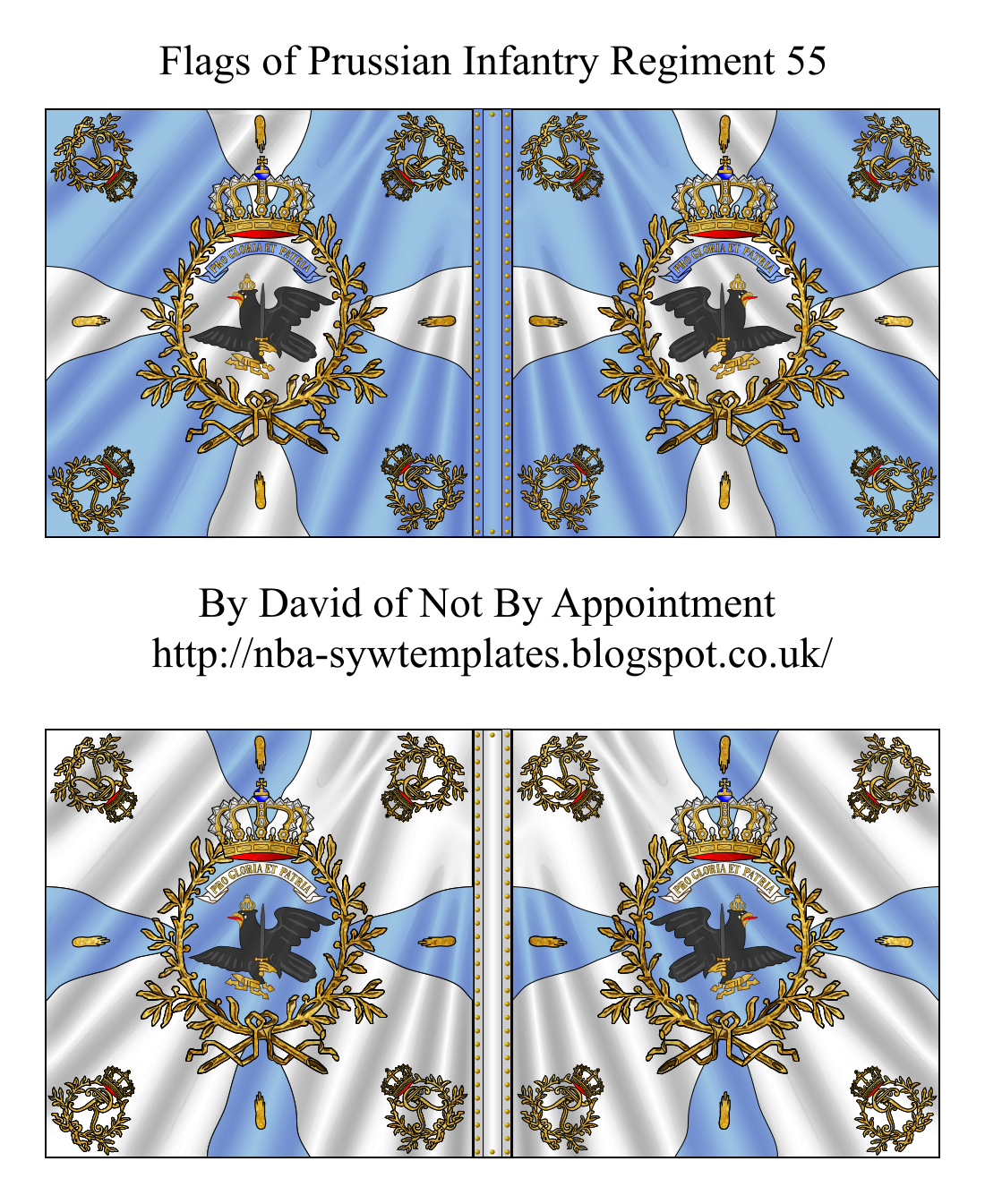
And this was the somewhat stripped down and simplified uniform:

IR56 (the former Saxon regiment Prinz Friedrich August) spent most of the war in garrison at Lübben and Guben. Kronoskaf says "On March 28 1757, the second battalion of the regiment mutinied. The first battalion did the same on March 29. They both escaped to Poland. However, the regiment was soon re-established with new levies. The regiment seems to have continued to assume garrison duties till the end of the war."
Duffy (Army of Frederick the Great) says: ""Restored after a mass desertion in March 1757. After the peace it took the place of the disbanded IR no. 32."

And this was the uniform:
Chefs: First raised 1741 by Major General Gerhard Cornelius von Walrave (who was sentenced to life imprisonment in 1748 for fraud and treason, and died in prison in 1773 at Neisse in a fortress he had himself designed); he was chef from the 8th January 1742; from 27th February 1748 Colonel Philipp Loth von Sers; from 26th November 1758 to 1770 Major General Christian Friedrich von Diericke, later Lieutenant General

And this was the uniform in 1758, with the unusual orangey-red smallclothes:

I wish everyone who visits my blog and enjoys my flags a Happy Christmas and New Year. 😀 Lots more flags to come in 2023, I hope...

I did think of doing one of my fantasy flags, as I did last year, for my Christmas post but then thought I'd rather do some real flags if I am going to put in some effort - and these French flags do have a slightly Christmassy look about them with their red and white (and blue).
Charrié says that the Colonel's flag carried the arms of the Goyon de Matignon family; these come in several different flavours so I have chosen those of the right period for the flags, I think. No doubt someone will tell me if I have got it wrong!
I like an authentic flag as much as the next man (probably even more so, as I am a registered Vexillomaniac :-)). On the Fife and Drum Forum there has lately been some discussion about adding flags to historical wargame units that (as far as we know) probably did not have them. My feeling is that, ultimately, we are playing with toy soldiers here and it is all our version of a fantasy of whatever period we are depicting, and so if we feel like doing so we should add plausible flags. Yes, I know, this is probably heresy, but in the end, for the horse and musket period, we mostly want something that looks good, don't we? I know that at least Willz Harley will agree with me that every unit should have a flag if at all possible. Even Willz's grenadier units carry flags - but they are admittedly ImagiNations units! I have done a number of speculative flags for people over the years for historical armies (e.g. https://nba-sywtemplates.blogspot.com/2022/08/speculative-but-plausible-flags-for.html ) and am currently doing some for the French 18th century Chasseurs de Fischers.
I have lately done flags for Lauzun's Legion in the AWI, which I posted on the Fife and Drum Forum and which prompted this discussion; the hussar guidon was carried by the later Lauzun Hussars from 1783-1791 but it seems perfectly possible that something similar might have been carried by the hussars of the Legion in the AWI. If they didn't, they jolly well should have done! ;-) The square standard is suggested for Lauzun's Legion in the AWI by the authors of "Officers and Soldiers of the French Hussars: 1 From The Ancien Regime to the Empire" André Jouineau and Jean-Marie Mongin, after discussion with acknowledged French flag expert Pierre Charrié. By which troops of the Legion it was possibly carried, they do not say.
Anyway, for those who might possibly like these flags, here is the sheet with the guidon and standard:
I look forward to comments! :-)
P.S. I have decided, to give my future French flag production some focus, to do the flags I have already not done for the Battle of Warburg 1760. That means 10 flags to do, including four Swiss and one French-German. That will bring my total of French flags posted on the blog to 100! Hurrah. :-) (Actually, it will be more than that, as for a number of flags I have done variants...)
I have quite a large backlog of flags waiting for their texts now but the recent cold weather has made the study, where the computer is, pretty uninhabitable except for very short spells of work; it has always been a very cold room but is much worse now the central heating has packed in! Even the small fan heater does not make much impression on the cold. We are promised a thaw now and hopefully that will make longer spells of work in the study more tolerable...
Anyway, domestic woes aside, I here present the flags of the French militia of Dunkerque (Dunkirk) to keep things ticking over on the blog. As I have said before, we have relatively little information on the French militia flags and this is one of the few that is known. The Milices Régionales were raised to protect the coasts and frontiers of France and were maintained by the provinces.

Although I concentrate on flags of the mid-18th century and earlier, I do on a whim sometimes do flags of other periods, although I do not often have time and energy to do so. So, as I have not posted any flags for a while and to keep things ticking over here while I am working on various flags and their texts including Prussian IR 49, some Austrian flags, more French flags and also more Spanish flags plus a flag commission etc. etc., I post here the flags of Swiss Regiment De Meuron in British service, both pre and post 1801. Someone might find a use for them! There are three versions of the King's Colour as I could find no definitive description of that colour but did find examples of those three versions of the flag. So it is up to whoever wishes to use them to choose the King's Colour they find most appealing!
The history of the regiment can be found here: https://en.m.wikipedia.org/wiki/Regiment_de_Meuron


I had a request recently on advice for resizing and printing my flags so thought I'd pass on the advice I gave to others who may find it useful. I suggest getting hold of the free Open Source Libre Office suite of programs https://www.libreoffice.org/ and using the Draw program within it, which is a vector drawing program. Drop the flags into a page in that program and you can resize them for printing without losing detail. DO NOT resize them in a bitmap program like Paint as you will reduce the number of pixels and badly affect the quality of the flags! If anyone needs further advice or help, send me a message via my Contact form (left column) and I'll do what I can to help. Or simply post a comment to this posting and I'll reploy below, as your query and the reply might help others...
First raised as a tercio in 1566. It saw much action in various conflicts in the 16th and 17th centuries. Much service in Spain in the War of the Spanish Succession including the battle of Almansa 1707, the battle of Gudiña 1709, the battle of Torrero 1710 and many sieges. Sent to Estremadura at the end of the war.
Flags carried from 1728-1768.


