Saturday, 11 June 2022

French Cavalry Standard - Du Roy Cavalry (and Royal Pologne and Royal Cravate)

Just to keep things ticking over while I work on the text for Prussian IR4, the flags of Prussian IR 15, the detail of another Austrian WAS flag from the Triomphes Louis XV, etc., etc., here is another French heavy cavalry standard, as the previous ones have gone down well:


Regiment first raised 1635. Ranked 5th amongst the French heavy cavalry. 2 squadrons strong in 1756. Increased to 4 squadrons in 1761. Served in the War of the Polish Succession and the War of the Austrian Succession. In the Seven Years War was at Hastenbeck 1758 and Borck 1761. Uniform was blue with red cuffs and lapels; waistcoat and breeches yellow; buttons pewter and lace on tricorn white. Wore the cuirass. Shabraque bordered with the Royal livery, red with white lace.


Note that, acording to Pierre Charrié, Royal Pologne and Royal Cravate carried identical standards, which is useful!

Tuesday, 7 June 2022

Experimental French cavalry standards - Bourbon and Bourbon-Busset

By way of experiment, I've done versions of the SYW standards of French cavalry regiments Bourbon and Bourbon-Busset. As this is a tentative posting I will not spend lots of time writing up the regimental histories or drawing the uniforms at the moment.

I say this is an experiment, as cavalry standards are often extremely detailed and yet the final product will be printed very small and so much of the laboriously created detail is likely to be lost in the printing, even on decent paper laser printed. These standards I have created have a fair amount of detail but I have tried to produce something that, when printed small, will still look good. As I don't have a laser printer (or even a working really good quality inkjet) at the moment, to produce decent printed versions, I'd be grateful if someone who does might be able to have a go at printing these and send me photographs. Thanks!


Wednesday, 1 June 2022

Flag of French Milice d'Autin 1689-?

Absolutely the last French militia flag for now. I could not resist this one either; I'm just having too much fun, with fancy flags and no complicated text to write! It's like a graphic artist's holiday. Ha ha.


Tuesday, 31 May 2022

Flag of French Milice de Lorraine 1742

I can find no information on this unit but rather liked the flag so here it is. It is unusual enough to please even ImagiNations users, I think! :-)


This (and the previous posting) was a somewhat unintended wander into the byways of French militia flaggery. I shall return again sometime but next I'll be back with Prussian, regular French and other flags.

I've now done the actual flags for Prussian Infantry Regiments 4, 11, 14 and 16 but still have to do the uniform plates and text, never a quick task.

Monday, 30 May 2022

Willz Harley's French Militia With My New Flag; French Militia Flag Also Posted

Willz Harley posted some shots of his nice French militia regiment on the Fife and Drum Forum yesterday. He did not have a proper militia flag so had used one of my white French colonel's flags. I had planned to do some French militia flags at some point, although, as Pierre Charrié explains in his splendid and comprehensive flag book Drapeaux Et Étendards Du Roi, we know very little about many of them. However, we do have details amongst others of the Milices de Sedans so I created the ordonnance flag yesterday evening and emailed it to Willz. He has now attached it to the standard bearer and sent me some pictures of the colour party; see attached images. At some point I will draw the colonel's flag of the bourgeois Sedan Militia and post it; it is more elaborate than the ordonnance flag.

Here are 3 of Willz's pictures which he said he would be happy for me to post here:


Willz has shown his militia in standard plain French uniform; we have little information on what many militia units wore and it is likely some wore civilian clothes.

This is his unit with the previous white flag:


Kronoskaf has useful summaries of what we know of the various militia units: http://www.kronoskaf.com/syw/index.php?title=French_Army#Militias

And here is the ordonnance flag of the Milices de Sedan for those who would like to use it for their Militia:


Tuesday, 24 May 2022

Flags and uniform of Prussian Infantry Regiment 2 von Kanitz

Having done the flags for Prussian infantry regiments at Prague, Kolin, Rossbach and Leuthen (apart from IR15 on which I am still working), I am now filling in the gaps in my coverage on the way to the ultimate ambition of doing all the Prussian infantry flags of the Seven Years War. The next regiments I do will therefore be IRs 2, 4, 11, 14 and 16. Here are those of IR2:

Chefs: 12th June 1750 to 1769 Major General Hans Wilhelm von Kanitz, later Lieutenant General

First raised in Far Pomerania and the Neumark December 1655.


In the Seven Years War 1757-9 the regiment had the pleasure of fighting the Russians in four major battles and suffering heavy losses. After the Russians moved into East Prussia on 1st August 1757, 73 year old Field Marshal von Lehwaldt moved against them and encountered superior Russian forces in the Norkitten Forest near Gross Jägersdorf. The regiment was part of the first attack, advancing with lowered bayonets and breaking through the Russian first line on the right wing and then, midst the fog and smoke, colliding with the second line of Russians. With no support from artillery or cavalry the attack crumbled in the face of Russian resistance. In the confusion the Sydow Regiment fired on the rear of the front line Prussian battalions which were then driven back by the Russian counter-attack. The regiment lost 16 officers and 489 men in the battle.

A year later on 25th August 1758 IR2 and six grenadier battalions led the initial attack on the Russians west of Zorndorf in the Zabern valley. The left wing under Lieutenant General von Kanitz (the regimental chef)  followed with fifteen battalions. There followed two hours of bitter combat. The left wing veered off to the right in the confusion and was attacked by Russian cavalry that threw it back. Prussian cavalry under von Seydlitz attacked the Russians and gave the left wing some much needed breathing space. But when the King began his main attack against the Russian left wing, Russian cavalry struck Kanitz's battered regiments. Frederick had now seen the East Prussian regiments "fail" twice and so, apart from IR2, they fell into disfavour. IR2 lost 20 officers and 844 men in the battle.  (Duffy, Army of Frederick the Great, 1st Edition (henceforth Duffy AFG1) shows around 45% casualties for IR2 at Zorndorf.)

On August 25th 1759 Lieutenant General Wedell, under what he saw as explicit orders from Frederick to attack the Russians, threw his army against them at Kay (Paltzig) even though they outnumbered him two to one. The assault against a prepared Russian position on the Paltzig Heights was inevitably a bloody failure. A third of Wedell's force were casualties and IR2 lost 13 officers and 642 men. The King himself then took command against the Russians and three weeks later, on August 12th, attacked the Russians and Austrians in their prepared positions at Kunersdorf, east of Frankfurt an der Oder. After initial success the Prussian infantry ground to a halt in the heat and dust of the Kuh-Grund in front of the Grosser Spitzberg. A final attack by Austrian and Russian cavalry under Loudon routed the struggling Prussians. The regiment lost nine officers and 472 men. (Duffy AFG1 shows around 25+% casualties for IR2 at Kunersdorf.) They had therefore in two years lost a total of 58 officers and 2447 men!

The remainder of IR2, one battalion strong, were captured by the Austrians at the Elbe bridgehead near Meissen on December 4th of that year. Having lost its own recruiting grounds and station, the regiment was sent to the Stutterheim Corps in Pomerania to be recruited with fresh recruits from Mecklenburg.

The grenadiers fought at Torgau on November 3rd 1760, in the third attack of von Hülsen. On August 1th 1762 the regiment fought in the victory of Reichenbach under von Bevern and then took part in the successful siege of Schweidnitz, which capitulated on October 10th.

Christopher Duffy, Army of Frederick the Great, 1st Edition says of IR2: "Unusually hard-fighting (especially for an East Prussian regiment) with consistently high casualties. One battalion captured at Meissen 4th December 1759." In favour with Frederick after the Seven Years War.

And this was the uniform in 1756:


Saturday, 21 May 2022

Flags of French regiments disbanded 1749: Flags of French Regiment Beauce

First raised 23rd September 1684

One battalion.


Summary of service from Susane Volume 8:

1689-1697: Served on the coast

War of the Spanish Succession:

1701: Army of Italy; blockade of Mantua. Then into garrison in that city.
1707: Army of Flanders
1708: Battle of Oudenarde
1709: Army of the Rhine
1710: Army of Flanders
1711: Combat of Arleux
1712: Sieges of Douai, Quesnoy and Bouchain

War of the Polish Succession:

1733: Army of the Rhine; siege of Kehl
1734: Siege of Philipsbourg
1735: Combat of Klausen

War of the Austrian Succession:

1742: Army of Bohemia; taking of Prague. Defence of Prague. Stayed there after the departure of the army. Obtained an honourable capitulation 26th December.
1743: Army of the Alps
1744: The colonel killed at the battle of the Madonna of Ulmo
1746: Battles of Plaisance and Tidone
1747: Conquest of Nice; combat of Exiles. Stayed in Italy up to the peace

The illustrious Chevert entered the regiment in 1710 as a sous-lieutenant; he was a lieutenant-general by 1748

1749 10th February; The regiment was incorporated in the regiment of Talaru, which later took the name of Beauce, and the grenadiers went to the Grenadiers de France

And this was probably the uniform in the later 1740s:


Wednesday, 18 May 2022

Kolin Prussian Flags Project - Flags of Prussian Infantry Regiment 22 Anhalt-Dessau

First raised March 1713.

Chefs: 31st May 1741-1760 Colonel Moritz, Prince of Anhalt-Dessau, later Field Marshall; 22nd April 1760-1768 Major General Balthasar Rudolf von Schenckendorf, later Lieutenant General


The regiment was with the King's army that took the Saxon army at Pirna; the grenadiers were at Lobositz. As IR22 was involved in the siege of Prague it missed the battle but was hard hit at Kolin 18th June 1757. It was part of the right wing under Bevern which should have been held back or "refused" to act as a reserve but Bevern's force "was plagued by misunderstandings which led to five of its battalions being led into an attack on the Prezerowsky Hill" (Duffy, By Force Of Arms). Although the decisive action of the battle was on the left wing, IR22 and its companion regiments suffered very heavy casualties in the final phase of the battle. IR22 lost 26 officers and 1165 men, four-fifths of its manpower. The grenadiers fought at Rossbach and Leuthen. (Duffy, Army of Frederick the Great, 1st Edition (henceforth Duffy AFG1) shows around 25% casualties for the grenadiers with IR17 at Leuthen.)

The prisoners taken at Kolin returned at the beginning of 1758 and IR22 joined the Pomeranian Corps that met up with  the King on August 22nd that year. On 25th August the army met the Russians at Zorndorf; IR22 was with its grenadiers. The regiment was in Kanitz's wing  and faced the Russian cavalry counterattack. Losses were heavy. (Duffy AFG1 shows around 25% casualties in both of IR22's musketeer battalions and 50& casualties in the grenadier battalion with IR17, which was in the advance guard.) The regiment was at the relief of Kolberg in October.

The grenadiers fought at Kay on July 23rd 1759 and the musketeer battalions took Frankfurt on the Oder under Wobersnow.  The grenadiers fought at Kunersdorf on 12th August. losing about 30% casualties (Duffy AFG1). The regiment marched from Pomerania under Kleist to join the King at Fürstenwalde.

It was with the King again in 1760 at the unsuccessful siege of Dresden July 10th to 22nd. The grenadiers were demolished at Landeshut. At Torgau on November 3rd it was in reserve with the main army. It was later part of the renewed attack under Hülsen that broke through and joined up with Zieten's attack, and decided the battle in favour of the Prussians, just when the Austrians were congratulating themselves on a victory. The commanders of both musketeer battalions received the Pour-le-merite.

IR22 was with the King again in 1761-2. At Burkersdorf 21st July 1762 it was part of the attack under Neuwied at Ludwigsdorf which stormed the defences there and captured them. Four company commanders were awarded the Pour-le-merite.

Christopher Duffy, Army of Frederick The Great, says of IR22: "Massacred at Kolin and suffered heavily at Zorndorf. On 5th January 1741 the regiment entered Breslau "in blue and red uniforms with straw coloured waistcoats... a splendid collection of men, with fine shining weapons that were a delight to see" (Steinberger)".

And this was the uniform in 1756 :


Sunday, 15 May 2022

Flags of French regiments disbanded 1749: Flags of French Regiment Vexin

First raised 31st August 1684 or 21st September 1684 or 1st December 1684 (depending on the source of the information)!

One battalion.


Summary of service from Susane Volume 8:

1689: Army of the Alps
1690: Battle of Staffarde
1692: Army of Flanders; siege of Namur
1693-1696: Army of the Alps
1697: Army of Flanders; siege of Ath

War of the Spanish Succession:

1701: Army of Flanders
1703: Battle of Ekeren
1704: Army of the Alps
1705: Taking of Chivasso; battle of Cassano
1706: Siege of Turin; battle of Castiglione
1707: Defence of Toulon
1708: Army of Dauphiné
1709: Army of Flanders; battle of Malplaquet
1711: Combat of Arleux
1712: Battle of Denain; sieges of Douai, Quesnoy and Bouchain

1727: Camp of Sâone

War of the Polish Succession:

1734: November; to Italy by sea
1735: Taking of Guastalla, Reggiolo and Revere
1736: September; back to France


War of the Austrian Succession:

1742: Army of Flanders
1743: Army of the Lower Rhine; battle of Dettingen
1744: Army of Flanders
1745: Army of the Rhine
1746: Army of the Meuse; siege of Namur; battle of Rocoux
1747: Battle of Lauffeldt
1748: Siege of Maastricht

1749 10th February; Incorporated in the regiment of Vermandois and the grenadiers to the Grenadiers de France

And this was probably the uniform in the later 1740s:


Wednesday, 11 May 2022

Kolin Prussian Flags Project - Flags of Prussian Infantry Regiment 7 Braunschweig-Bevern

This is a very short mini-project as Prussian Infantry Regiments 7 and 22 are the only infantry regiments missing from my blog for the battle of Kolin 18th June 1757 (except for the flags of Prussian IR15 which I have been endlessly putting off doing as they are uniquely complicated and a lot of work... Must get them done sometime, though).

Chef: 1741-1781 Colonel August Wilhelm, Prince of Braunschweig-Bevern, later Duke and General of the Infantry, Governor of Stettin

First raised as a full regiment November 1676.


In the Seven Years War: At Lobositz on October 1st 1756 the regiment stormed the Lobosch Hill with the bayonet, having run out of ammunition, and the officers of the regiment received eight Pour-le-merite medals for its conduct that day. (Duffy, Army of Frederick the Great, 1st Edition (henceforth Duffy AFG1) shows around 15% casualties.) On 21st April 1757 the regiment spearheaded the advance through the mountains to Bohemia near Reichenberg. Having missed Prague on 6th May, the regiment was in the first line and leading brigade at Kolin on 18th June. It led the advance onto the Krzeczhorz Heights. In the afternoon it stormed an Austrian battery which had been doing great damage to it. After the Prussian cavalry had driven off an Austrian counterattack, IR7 threw itself at the enemy once more in a bayonet attack which captured some enemy guns. But the battle was already lost and IR7 suffered very heavy casualties in the final Austrian and Saxon cavalry attack. IR 7 lost 26 officers and 1018 men. (Duffy AFG1 shows around 75% casualties.) The regiment was not restored to full strength until the following winter.

At Zorndorf on August 25th 1758 the regiment suffered heavy casualties as part of Kanitz's wing which drifted to the right and hit the centre of the Russian position. (Duffy AFG1 shows around 40% casualties.)

1759 was a very bad year for the regiment, which took part in the defeat at Kay (Paltzig) on July 23rd and then on August 12th at Kunersdorf, where the grenadiers alone suffered 117 dead and 200 wounded. (Duffy AFG1 shows around 45% casualties amongst the grenadiers (with IR30) and about 15% in IR7 itself.)

At Torgau on November 3rd 1760 the regiment was with Hülsen and twice attacked the Süptitz Heights in vain, suffering heavy losses. At Freiberg on October 29th 1762 it tasted success, capturing five cannon and a flag, as part of the southern attack under General von Stutterheim.

Duffy AFG1 says of the regiment: "Saw especially heavy fighting at Hohenfriedberg, Kolin and Zorndorf. Frederick regarded it as a typically reliable Pomeranian regiment and one that "had done honour to the House of Brandenburg from time immemorial". The genial Duke of Bevern was Chef for 40 years."

And this was the uniform in 1756:


Sunday, 8 May 2022

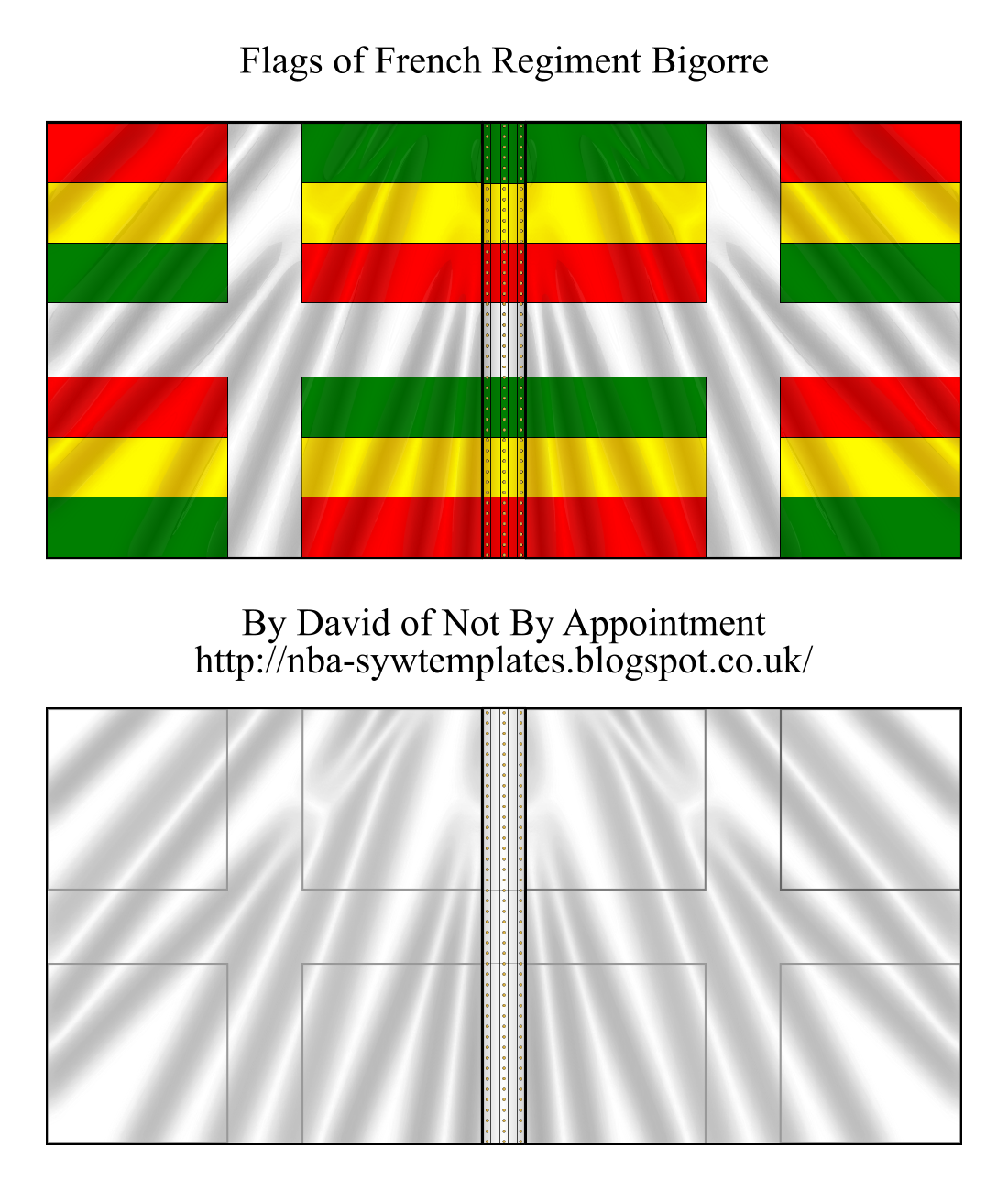
Flags of French Regiment Bigorre 1684-1762

First raised 9th September 1684 and created from companies of Regiment Navarre. One battalion. Ranked 78th in the SYW.


Flags carried from 1684-1762

Summary of Service History (from Susane Volume 8):

1690: Army of the Alps; taking of Cahours and Suze; battle of Staffarde
1691: Conquest of Savoy and Nice
1693: Battle of Marsaglia
1696: Siege of Valenza
1696: Army of the Moselle
1700: Army of Italy
1701: Combats of Carpi and Chiari. Into garrison at Mantua
1705: Army of Spain. Conquest of Andalucia
1707: Siege of Lerida
1709: Army of Dauphiné
1710: Army of Flanders
1712: Sieges of Douai, Quesnoy and Bouchain
1733: Army of the Rhine
1734: Siege of Philipsbourg

WAS
1743: Army of the Lower Rhine; battle of Dettingen; combat of Rheinweiler
1744: Retaking of the Lines of Lauter; siege of Fribourg
1745: Taking of Kronembourg
1746: Army of Flanders; battle of Rocoux
1747: Defence of Provence; the recapture of the Isles of Sainte-Marguerite; conquest of Nice
1748: Defence of the Rivière de Gênes, Italy

SYW: Served on the coast of Brittany; defence of Belle-Île-Sur-Mer 1761

Disbanded 25th November 1762

And this was the uniform in the SYW:


Wednesday, 4 May 2022

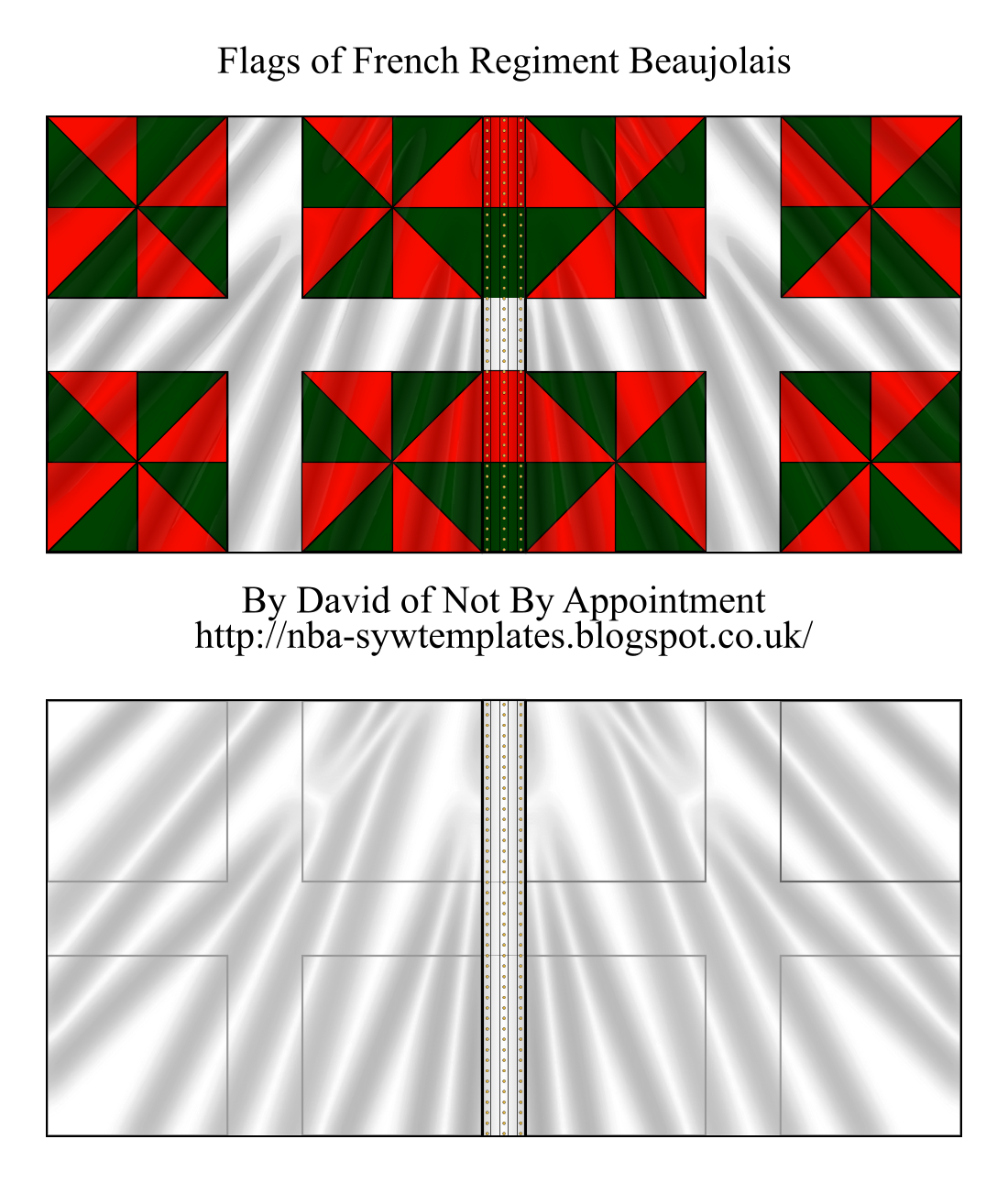
Flags of French regiments disbanded 1749: Flags of French Regiment Beaujolais

Beaujolais first raised June 1685. One battalion.


Summary of its service (from Susane):

    1690 : Army of the Alps
    1691 : Conquest of Savoy and Nice
    1693 : Battle of Marsaglia (4th October))
    1696 : Army of the Rhine
    1701 : Army of Germany, then to the Army of Italy; battle of Chiari
    1702 : Combat of Santa Vittoria; taking of Luzzara and Borgoforte
    1703 : Expedition to the Tyrol
    1704 : Sieges of Verceil, Ivrée and Vérue. The colonel, killed before Verceil, was replaced by his       brother Etienne Le Ménestral de Hauguel de Lutteaux 20th July 1704
    1705 : Battle of Cassano (16th August))
    1706 : Battle of Castiglione
    1707-11: Army of Dauphiné
    1712: Army of the Rhine
    1713 : Sieges of Landau and Fribourg
    1719 : Army of the Pyrenees
    1733 : Occupation of Lorraine
    1742 : Army of Flanders
    1743 : Army of the Lower Rhine; battle of Dettingen
    1744 and 1745 : Defence of Alsace
    1746 : Siege of Namur; battle of Rocoux
    1747 : Went to Provence. Retaking of the Isles of Sainte Marguerite; conquest of the County of Nice; combat of the Assiette, where the colonel Jacques Gabriel Bazin Marquis de Bezons was seriously wounded
    1748 : Campaigns on the Rivière de Gênes, Italy
    10th February 1749 : incorporated in the Regiment de Traisnel, which became Beaujolais, and the grenadiers sent to the Grenadiers de France
    
And this was the uniform in the 1740s:


Thursday, 28 April 2022

Prague Prussian Flags Project - Flags of Prussian Infantry Regiment 3 Anhalt-Dessau; then von Kahlden; latterly Anhalt-Bernburg

Chefs: From 23rd December 1752 Major Colonel Leopold Friedrich Franz, Hereditary Prince of Anhalt Dessau later Major General ; from 5th January 1758 Major General Henning Alexander von Kahlden, died 22nd October 1758 of wounds received at Zorndorf; from 31st March 1759 Major General Franz Adolf, Prince of Anhalt-Bernburg,  later Lieutenant General, to 1784


The regiment was at Lobositz on October 1st 1756 and was thrown in as the last reserve to help with the attack on the Lobosch Hill after the cavalry fight in the plain below. At Prague it was part of the right wing's first line under Braunschweig-Bevernand which broke through the Austrian line south of Kej. Casualties were heavy in the fight round the Rokenitz Brook. (Duffy, Army of Frederick the Great, 1st Edition (henceforth Duffy AFG1) shows around 40% casualties.) At Kolin on 18th June (without its third battalion) again it was on the right wing under the Duke of Bevern, and it was claimed that Bevern's inaction assured the defeat. It then helped protect the retreat at Planjan. (Duffy, AFG1, shows about 50% casualties.) On November 22nd the grenadiers suffered defeat at Breslau and then enjoyed victory at Leuthen on December 5th  (Duffy, AFG1, shows about 20% casualties) .

As a result of the loss of a battalion at Kolin the regiment did not see service again until the battle of Kay (Paltzig) on July 23rd 1759; its three battalions of the avant garde were commanded by Lieutenant-General von Manteuffel. Under heavy artillery fire the regiment fought through to the Russian gun positions but was thrown back with heavy losses. Four further attacks had the same result. On December 12th seven companies of the regiment were captured by the Austrians on the right bank of the Elbe at Meissen.

When Frederick surrounded Dresden on July 10th 1760, the first two battalions of the regiment were routed with heavy losses in the Pirna suburb as far as the Grosse Garten, during a night attack by the enemy forces in the city on July 21st. The King was furious and demoted them to garrison duty. He also took away the other ranks' sidearms and also the braid on the hats of the officers and NCOs. The army was deeply impressed by this punishment. Three weeks later at Liegnitz the regiment redeemed itself by charging at the Austrians and breaking through their lines and forcing Loudon to withdraw his battered command over the Katzbach.  (Duffy, AFG1, shows about 45% casualties.) The King restored the regiment to favour, paying for the braid on the hats out of his own pocket.

IR3 attacks the Austrians at Liegnitz (Menzel)

Frederick gives IR3 back its sidearms and hat braid (Röchling)

In 1762 the regiment under its commander Major General Franz Adolf, Prince of Anhalt-Bernburg captured Leutmannsdorf but lost the commander of its second battalion. The regiment was awarded two Pour-le-merite medals for the action.

Christopher Duffy (AFG1) says: "In the Seven Years War it was filled up with impressed Saxons and performed erratically, disgracing itself at the siege of Dresden in 1760 but redeeming its name at Liegnirz late  in the same year." It was quite highly regarded by Frederick after the war.

 And this was the uniform in 1756:


Friday, 22 April 2022

Flags of French regiments disbanded 1749: Flags of French Regiment Agénois

First raised under this name October/November 1692.

Flags carried from 1692-1749, although the later violet colour was called "gris de lin" up to the 1730s. This may have been little different from the later violet. These flags are one of my favourite sets of the disbanded regiments and I have planned to do them for a long time.

I took the detail of the design from the 1721 French MS as about the closest we have to a definitive version of these flags...


Service (from Susane Volume 8); it saw a great deal of action in the War of the Spanish Succession:

In the Army of Germany up to 1694.

Campaigns of 1695, 1696 and 1697 in Flanders.
; siege of Ath.

Army of Flanders 1701.

Combat of Nimègue 1702.

Moved to the Army of the Rhine; battle of Friedlingen 1702.

Siege of Keth and campaigns in Bavaria 1703.

Battle of Blenheim [2nd Hochstedt] 1704; first battalion taken prisoner.

Army of Flanders: Battle of Ramillies in 1706.

Battle of Oudenarde 1708.

Battle of Malplaquet 1709.

Battle of Denain 1712; the colonel of the regiment was badly wounded there.

Army of the Rhine: Siege of Philipsbourg 1734.

Combat of Klausen 1735.

Campaigns of 1739 and 1740 in Corsica.

Army of Bavaria in 1742: relief of Braunau and defence of Deckendorf.

In garrison at Bitche in 1743.

Army of the Alps in 1744; the colonel was killed in the attack on the fortifications of Montalban.

Served in the Alps up to the peace.

Incorporated on the 10th February 1749 in the regiment of Berry and the grenadiers in the Grenadiers de France.

And this was the uniform in the 1740s:


Friday, 15 April 2022

French Flags Mini-Project: Flags Carried By Infantry Regiments at St Cast 1758 Number 5: Regiment Bourbon

This concludes the mini-project as this was the last regular French infantry regiment that fought there, although I may also do the flags of the Volontaires Étrangers who fought at St Cast.

First raised 1635 as Regiment d'Enghien and renamed Bourbon in 1686. Ranked 39th in 1756. Two battalions strong.


Flags carried from at least 1686-1791.

Early history:

Susane lists the regiment's activities in the various civil and other wars of the early 17th century but I shall not recount them here. Kronoskaf here: http://www.kronoskaf.com/syw/index.php?title=Bourbon_Infanterie gives an account of the regiment's many activities in the Nine Years' War, the War of the Spanish Succession and the War of the Austrian Succession based largely on Susane.

Bourbon in the SYW from Susane Volume 6 - my translation:

Bourbon took part in the Saarlouis camp in 1753. It served on the coast of Brittany during the six first campaigns of the Seven Years War. It was particularly distinguished in 1758 in the combat of Saint Cast. At the news of the British landings, the regiment gathered on the 10th September at Lamballe, and the affair took place the next day. It attacked the enemy on the right [flank] and, despite the fire of the enemy ships which swept the beach, it threw the British battalions opposed to it into the sea. The colonel-lieutenant le Marquis de Broc, whose conduct had been most notable, was charged by the Duc d'Aiguillon to carry the news of the victory to Versailles.

At the beginning of 1759 Bourbon was sent to Belle Isle. There it spent two years without being attacked. On the 7th April 1761 115 British ships tried to disembark their troops at Port Andras. The regiment surprised the enemy in the middle of the operation, killed 800 of them, nearly all grenadiers, and made 300 prisoner including a lieutenant colonel and a major. But the British made another attempt on the 21st and were luckier. The lieutenant colonel the Chevalier de Sainte Croix defended with great courage up to the 7th June and did not agree to surrender until he had lost all hope of relief. He obtained an honourable capitulation for the regiment which was transported by British ships to the mainland and sent to Arras. It left that town in December 1763 to go to Dunkirk.

And this was the uniform in 1756:


Tuesday, 12 April 2022

Prague Prussian Flags Project - Flags of Prussian Fusilier Infantry Regiment 41 Wied

The Prague Prussian infantry flags project moves towards its close with this, the penultimate flag set. It is not one of the most exciting or attractive sets of these flags nor is the last flag set, that of IR3, which will be posted sometime soon. After that I may, as part of the plan ultimately to post all the Prussian infantry flags, work on the the flags carried at Kolin that have not already been produced in this and previous projects.


Chef: 27th July 1746 to 1765 Colonel Franz Carl Ludwig, Count von Wied zu Neuwied, later Lieutenant General


First raised for the service of Württemberg in 1716, the regiment was taken into Prussian service in 1741.


The regiment took part in the siege of Pirna in 1756. Increased by 300 men in January 1757, it went to Bohemia in April 1757 and fought at Prague on May 6th as part of the second line, right wing, reinforcing Hautcharmoy's division in the breakthrough south of Kej. It fought at Kolin on June 18th along with its grenadiers. The regiment was taken out of the second line of the left wing by the King and sent into the gap between Prinz Franz and Pannewitz's Brigades to launch a new attack on the Krzeczhorz Heights. The King himself led the attack with drawn sword and the attack succeeded around 5.30pm. In the battle's finale at Novemesto the grenadiers helped protect the retreat of the second line's right wing, with the artillery, wounded and fugitives. The regiment lost 1018 men including its commander Colonel Herwarth von Bittenfeld. (Duffy, Army of Frederick the Great, 1st Edition (henceforth Duffy AFG1) shows around 75% casualties; the grenadiers with IR44 lost about 25% casualties.) In August it was sent with Bevern to Silesia. On September 7th the grenadiers were part of the defence of the Jäckelsberg at Moys and lost 204 dead and 68 wounded. On November 22nd in the battle for Breslau the regiment stood its ground and then at Leuthen in December it fought on the right wing, losing 79 dead and 73 wounded.


In 1758 the regiment fought in the siege of Schweidnitz; the grenadiers stormed the Gallows Fort on April 16th. The grenadiers fought at Domstadl and the musketeer battalions in the defeat at Olmütz June 1st to July 1st. On the march back to Landeshut the regiment captured Kronau, which was held by eight grenadier companies. On August 11th the King took it to join Dohna’s Corps. It occupied the ruined city of Küstrin and then helped secure Lusatia against the Austrians. At Hochkirch on October 14th the grenadiers were on the right wing near the village and suffered about 30% casualties (Duffy AFG1) and the rest of the regiment fought against the Swedes at Fehrbellin under Wedell in October before moving to Torgau to secure the Mulde.


In 1759 it was sent to Franconia with the Saxon Corps. In August at Kunersdorf it suffered very heavy losses in the Kuhgrund including its regimental commander Colonel von Böhm. (Duffy AFG1 shows about 40% casualties.) At Maxen the grenadiers were taken prisoner. At Liegnitz on August 15th the regiment led the counterattack on Panten and the commander received the Order of the Black Eagle in consequence. At Torgau on November 3rd the regiment was with Zieten in the Tettenborn Brigade and took the village of Süptitz in the attack from the south that decided the battle after the Austrians thought they had won it.


In 1761 and 1762 the grenadiers fought in Pomerania and Upper Silesia and the two musketeer battalions were with the King at Peilau on August 16th, their last action of the war.


In 1763 the regiment had 1093 Prussians, 125 Saxons and 402 foreigners. The regiment was one of those most highly favoured by the King.


And this was the uniform in 1756:


Thursday, 7 April 2022

Flags of French regiments disbanded 1749: Flags of French Regiment Gâtinais

This will possibly be the start of another mini-project, as part of the overall plan to do probably just about every French infantry flag from the 17th to the 18th centuries, if I live long enough. As was true of so many countries, the variety of French flags diminished as the 18th century wore on. Many of the War of the Spanish Succession flags are wonderfully psychedelic and unusual; the flags of the regiments disbanded at the end of the War of the Austrian Succession are also mostly unusual designs, no longer used by the French army after that date. I find the WAS more and more appealing, although I am sorry that the Austrian army was so much less effective in that war than in the Seven Years' War!


The flags of Gâtinais are often depicted with the diagonal designs as pointed triangles but the 1721 MS shows them as here. I trust the 1721 MS as a probably more authentic version of these flags. I would be interested to hear if anyone has evidence to the contrary.

The following summary of the regiment's history is from Susane, Volume 8:

Gâtinais was first raised October 1692. Only one battalion strong for much of its existence.

    1693 : Army of Italy, Battle of Marsaglia (4th October))
    1695 : Army of Catalonia
    1697 : Siege of Barcelona
    1701 : Army of Germany, then to the Army of Italy; battle of Chiari
    1702 : Defence of Cremona, battle of Luzzara, taking of Luzzara, Guastalla, and Borgoforte
    1703 : Battles of Stradella and Castelnuovo; expedition to Tyrol; taking of Asti
    1704 : Sieges of Verceil, Ivrée and Verrue
    1705 : Taking of Mirandola; battle of Cassano (16th August))
    1706 : Siege and battle of Turin (14th May); battle of Calcinato (19th May)
    1707 : Defence of Toulon
    1708 : Dauphiné, attack on Cézanne
    1708 - 1712 : Remained in the Alps
    1713 : Army of Roussillon
    1714 : Siege of Barcelona
    1733 : Army of Germany; siege of Kehl (13th-29th October)
    1734 : Battle of Ettlingen, siege of Philippsbourg (2nd June to 18th July)
    1735 : Battle of Klausen
    1744 : Army of the Alps; Conquest of Nice; siege and battle of Coni (30th September)
    1746 : Battle of Tidone
    1747 - 1748 : Defence of Provence
    In garrison at Toulon and Saint Tropez up to the Peace of 1748
    10th February 1749 : became the 2nd battalion of Lorraine and the grenadiers sent to the Grenadiers     de France

And this, as far as I can tell, was probably the uniform in the WAS. The various volumes of the Abregé De La Carte Générale Du Militaire De France from the 1730s do not specify the pocket detail or numbers of buttons on the cuff or pockets. Rousselot depicts them from 1720-1736 as shown here so in the absence of any other authorities I have chosen to do so too. Again, if anyone has better information, please do let me know in the comments below!


Tuesday, 29 March 2022

French Flags Mini-Project: Flags Carried By Infantry Regiments at St Cast 1758 Number 4: Regiment Boulonnais

The regiment was first raised in 1684, of two battalions. It saw much action in the War of the Spanish Succession, serving at the battle of Blenheim, where most of the first battalion was captured, and subsequently, amongst other actions,  at Oudenarde, Wijnendale, Malplaquet, Denain and various sieges.

Only one battalion in much of the Seven Years War and ranked 74th.

The flags were the same from 1684-1791.

My translation of Susane's account of the regiment in the SYW, Volume 7:

At the beginning of the Seven Years War Boulonnais was in garrison in Brittany. It remained attached to the defence of the coast of this province and was at St Malo during the various attempts at bombardment of this city by the British. On the 11th September 1758 it was this regiment that threw the British into the sea at St Cast. A considerable body of British troops managed to land on the 4th at St Lunar close to St Malo. This body had sized the position of St Cast and rapidly surrounded it with entrenchments. The Duc d'Aiguillon, governor of the province, got together all he could find of regular and militia troops but hesitated to attack a fortified enemy with so few troops. Boulonnais, led by its colonel La Tour d'Auvergne, hastened to engage the enemy, followed by the regiments Brie and Marbeuf. They broke into the entrenchments, despite the musketry of the British troops and the cannon fire from their fleet nearby, and forced the enemy to abandon their position and retreat to the shore. Boulonnais then harrassed the left, pushed it towards the sea and followed the enemy into the water up to waist height and during the entire re-embarkation fought hand to hand with men in despair. The carnage was frightful; 200 British troops were killed or drowned, and an equal number who could not reach  their ships and who sought their salvation by climbing the rocks were captured after the combat. Boulonnais, which had fought under the constant barrage of the fleet, also had great losses; its colonel was dangerously wounded.

In 1761 the regiment was sent to Saint Dominica, and because of that it escaped the reforms of 1762 which led to the disappearance of the greater part of its contemporaries. An Ordonnance of 30th April 1762 increased it to two battalions, incorporating various detachments of other troops which were also in the colonies. The regulation of the 10th December of the same year attached the regiment to the service of ports and colonies.

And this was the uniform in 1756:


Saturday, 26 March 2022

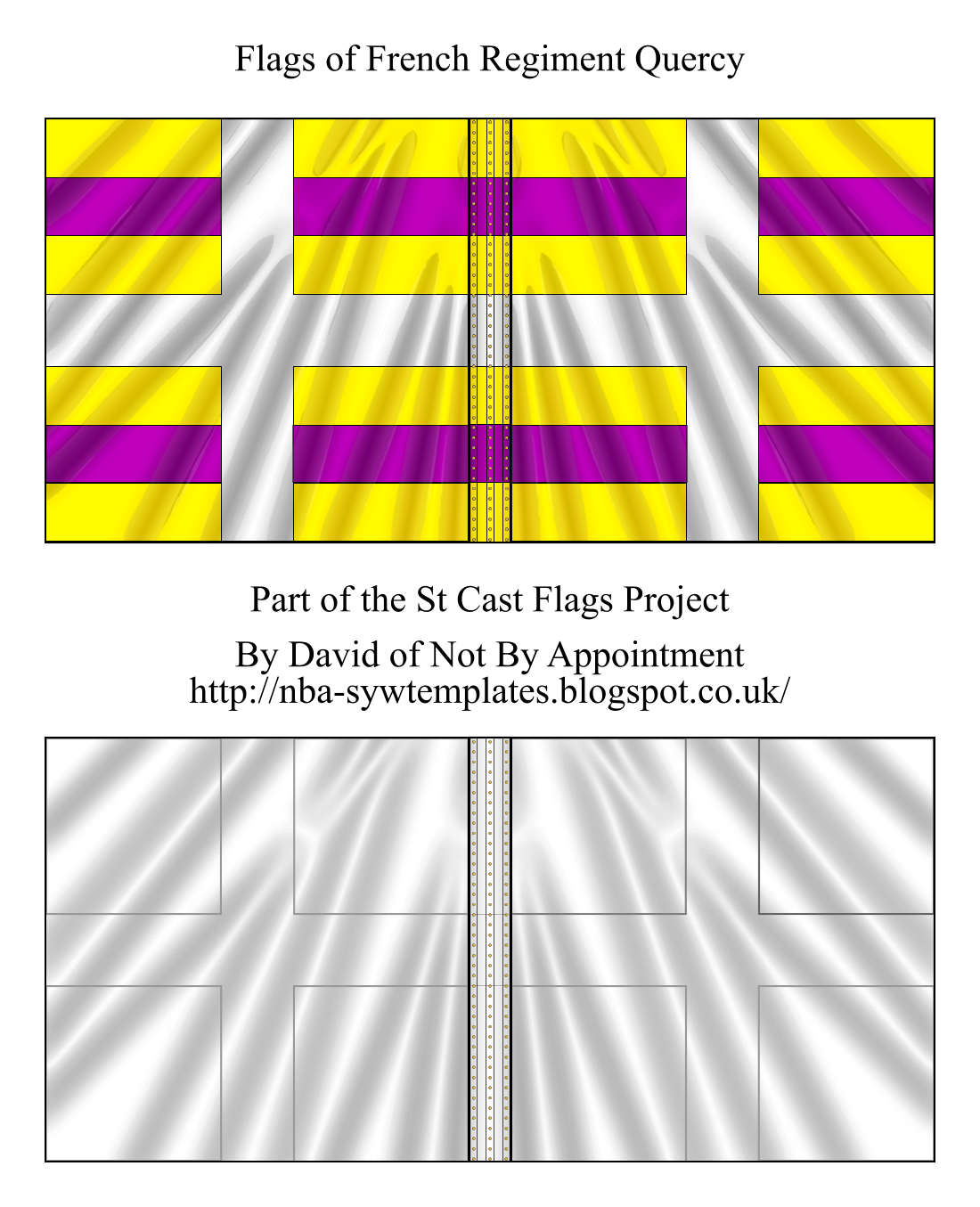
French Flags Mini-Project: Flags Carried By Infantry Regiments at St Cast 1758 Number 3: Regiment Quercy

First raised 16th September 1684. One battalion in 1756 and ranked 85th.

These flags were carried at least from 1694-1776.


Summary of Susane Vol.7's account of the regiment's early history: Active in the War of the League of Augsburg. In 1692 its colonel and major were killed in a sortie by cannon fire during the enemy siege of Embrun which the regiment was helping garrison; after an honourable capitulation the regiment retired to Pignerol in 1693. Took part in the battle of Marsaglia 1693. It continued to serve until 1696 to the Peace of Ryswick 1697.

Raised to two battalions in June 1701. The first battalion served in Italy from December 1700 and was at the battles of Carpi and Chiari. In 1701 as part of the Auvergne brigade it was distinguished at the combat of Santa Vittoria where captain of grenadiers Monteil was killed. With Marshal Vendome in his campaign of 1703. In garrisons in 1704 then in 1705 at the siege of Vérue and after its capitulation then at the siege of La Mirandole. Later at the battle of Cassano. Fought 19th April 1706 along with Regiment Limousin at Calcinato, at the siege of Turin, and then at the battle of Castiglione 9th September. In 1707 at the defence of Provence and Dauphiné. Took part in the taking of Césane 1708 then serve din the Alps in the following years where it finally rejoined by the second battalion.

The second battalion had served in Flanders under Marshal Villeroi up to 1703. Served on the Moselle until the end of 1710 and left Brissach, where it had been in garrison, for Dauphiné at the beginning of 1711.

The entire regiment served in the Alps for the three following campaigns and in 1714 was called to the siege of Barcelona. After the capitulation of that city the regiment was reduced to one battalion and incorporated part of the regiment of Vallouze.

The regiment served in many of the actions of the War of the Polish Succession from 1733-6.

At the beginning of the War of the Austrian Succession the regiment was again on the Alps frontier and saw much service there. After the disasters of the campaign of 1746 the regiment took a heroic part in the defence of Provence and made a great contribution in the raising of the siege of Antibes by the Austro-Sardinians. Recrossing the Var in 1747 it was distinguished in the attack on the fortifications of Montalban and Villefranche and the capture of the two towns, almost a repeat of its experiences there in 1744. After that it took part in the occupation of Nice and Vintimiglia. At the time of the peace it remained in the Comté of Nice.

Text for the Seven Years' War from Susane Volume 7; my translation.


During the first years of the Seven Years War, the regiment de Quercy was employed in the defence of the coast of Brittany and its conduct was notable, on the 11th September 1758, at the battle of St Cast, where the British flag received a bloody affront. While Boulonnais attacked the enemy left flank, Quercy marched at the head of the column attacking the other flank. It was a lieutenant of the regiment, followed by fifteen grenadiers, who was the first to enter the enemy entrenchments and began the rout of the British troops.

In 1760 Quercy was part of the tardy reinforcement sent for the defence of our [i.e. France's] colonies. It was put into garrison on Saint Domingo, where it stayed until the beginning of 1766. An ordonnance of 30th April 1760 had raised it to two battalions and that of 10th December of the same year assigned the regiment to the service of ports and colonies.

And this was the uniform in 1756:


Wednesday, 16 March 2022

Flags of French German Regiment Bentheim

First raised in Germany as Furstemberg in 1668 then joined the French army in 1670 as a foreign regiment. Name changes included Sparre, Greder and then Saxe 1720 to 1750 before becoming Bentheim. Two battalions in the SYW and ranked as number 46.

I take the design of the outer border and stripes from the 1721 French MS (which shows the flags when the regiment was still called Sparre with the same design as later but in different colours) and from the 1757 MS. This differs from the way the design is often depicted but I think those two sources are likely to offer a more authentic version of the design.


The regiment was very active in the Franco-Dutch War of 1672-8, the Nine Years' War 1688-97, the War of the Spanish Succession 1701-13 including the battles of Blenheim, Oudenarde and Malplaquet, the War of the Polish Succession 1733-35 and also the War of the Austrian Succession 1740-48, where much of its work involved sieges and the capture of various towns.

Susane Vol.6 on Bentheim in the Seven Years' War (my translation):

In October 1756 the regiment, now called Bentheim, was destined to take part in the relief efforts which the king intended to send to the Empress [Maria Theresa] but the order was never given and Bentheim became part of the Army of the Lower Rhine in 1757. It did not take part in any prominent action during the first two campaigns of the Seven Years' War. One finds it in 1758 in garrison at Gottingen and later at Drantzfeld.

In 1759 it belonged to a colonel who probably cared more than his predecessor about the reputation of his regiment; for one finds it, on the 13th April, at the battle of Bergen where Captain de Nardin was killed. On the 1st August, it fought with honour at the battle of Minden, where it was on the extreme right wing with regiments Auvergne and Aquitaine. But it was distinguished above all, on the 8th, during the retreat through the gorges of Munden, at the combat of Eimbeck. Colonel-commandant de Courvoisier, aide-major Freytag, captains de Vanaltz and Culmann, and four lieutenants were wounded there.

On the 18th of January 1760 the regiment of Anhalt [formerly Bentheim] was increased to three battalions by the incorporation of the first battalion of the regiment of Lowendhal. It fought with spirit on the 10th July at Corbach; but on the 16th it allowed itself to be surprised by the Hereditary Prince of Brunswick and part of the regiment was made prisoner of war. The Prince of Anhalt, surrounded by the British, was going to perish and owed his salvation only to a soldier of Royal-Bavière who deflected the blow aimed at him. The Prince became a prisoner. His regiment remained as a garrison unit for the following two campaigns and was reduced to two battalions by the Ordonnance of 21st December 1762.

At the moment peace was declared Anhalt was in garrison at Metz.

And this was the uniform in 1756:


Saturday, 12 March 2022

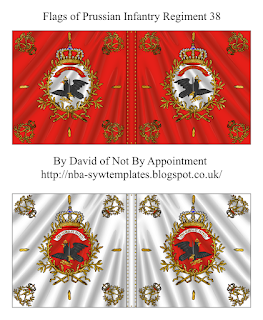
Prague Prussian Flags Project - Flags of Prussian Fusilier Infantry Regiment 38

Chefs: Major General Johann Christoph von Brandes, later Lieutenant General 24th August 1749-1758, then Major General Anton Leopold, Baron von Zastrow,  later Lieutenant General 20th December 1758 to 1766

First raised June 1740 from men of Garrison Regiments 1 and 2, junior officers of IR6, officers of other regiments and foreigners recruited from the Empire.


In the Seven Years War, it was with the King's Army to the surrender of the Saxons at Pirna on October 16th 1756. The companies were given an additional 30 men in January 1757. On May 6th the regiment joined the King's army at Prague. In the battle it was part of the right wing breakthrough after the massacre of the first line. The grenadiers (with IR12) suffered heavily on the left flank initial attack, losing 278 men. After Kolin the siege of Prague had to be abandoned and the regiment marched to Silesia with Bevern. After Moys and Barschdorf it was at Breslau from September and in the battle of 22nd November it was on the right wing as were its grenadiers under its chef Lieutenant General von Brandes. The position was held until nightfall and each battalion of the regiment lost about 300 men, as well as Colonel von Geiss. Breslau was evacuated on November 25th on terms of "free departure"; in the process nine-tenths of the Prussian troops deserted. The sorry remnant of the regiment returned to Berlin to be reformed. In 1758 replacements were mostly from the Mark and some of the Upper Silesians of the regiment returned after Leuthen. The grenadiers (with IR43) lost about 50% casualties at Zorndorf in August 1758 (Duffy, AFG1).

As part of the Saxon Corps the regiment advanced to Hof and Bamberg, and was part of the attempt to secure Saxony at Zschopau, Pirna and Dresden. At the end of July 1759 the regiment went with the King to Bautzen and then to Kunersdorf in August. At the battle on August 12th IR 38 was in Finck's Corps on the right wing, which opened the attack over the Trettin Heights. The regimental commander Colonel von Steinwehr was killed along with nearly 50% casualties in the regiment (Duffy, AFG1).

One battalion fought with Wunsch's Corps in Saxony, at Torgau and Korbitz, and was then captured at Maxen under Finck on November 21st 1759.

In 1760 its sole battalion was part of the garrison of Schweidnitz and captured there on October 11th. As prisoner exchange had ended it was not reformed in 1762 but after the return of prisoners in February 1763 it was reformed with the grenadier battalion of Rotkirch, formerly Köller, which had been raised from Saxon grenadiers in 1757 and served in Pomerania from 1761.

In 1784 the king complained of the regiment and its "wretched commander", who was Major General von Hager.

 And this was the uniform in 1756:


My flags "in action" - and a SYW wargame of the battle of Moys...

Willz Harley has kindly sent me more pictures of my flags with his splendid troops. He has been very busy painting lately! Here is a sample beginning with Prussian IR17:

and next Prussian IR 5:

and


Next, Prussian IR37:


A Prussian garrison regiment:


Next, Prussian IR6:

And the last of Willz's pictures for now, the French Grenadiers de France:

Konstantinos Antoniadis uses many of my French flags in his splendid and extensive 15mm army and they can be seen in many of the pictures on Flickr here:https://www.flickr.com/photos/142494696@N04/

Nigel Billington has been using my French flags and they can be seen looking good with his excellent figures on his blog here, for instance: https://nigbilpainter.blogspot.com/2022/01/28mm-syw-french-infantry-ir14-poitou.html and here: https://nigbilpainter.blogspot.com/2021/12/28mm-syw-french-infantry-ir25-limousin.html and here: https://nigbilpainter.blogspot.com/2021/11/28mm-syw-french-infantry-ir86-comte-de.html

And finally for now, I am very pleased to say that I have actually had a SYW wargame, the first in a very long time, thanks to the kindness and generosity of Jon Freitag, an American gamer. It was a remote game, using Zoom. We refought the Battle of Moys 1757 and you can find a very detailed and well illustrated account here: https://palousewargamingjournal.blogspot.com/2022/03/combat-of-moys-battle-report.html?showComment=1647032500554#c8142437012420189917

Here is a snapshot from the battle, showing my Austrian grenadiers, after a bloody fight to expel the Prussian grenadiers holding it, in possession of the Jackelsberg hill which they successfully held onto for the rest of the game:


Jon also uses my French flags and they can be seen on his blog: https://palousewargamingjournal.blogspot.com/2022/03/french-regiments-beauvoisis-and-la.html and https://palousewargamingjournal.blogspot.com/2022/02/french-regiments-provence-and-cosse.html for example.