Saturday, 12 March 2022

Prague Prussian Flags Project - Flags of Prussian Fusilier Infantry Regiment 38

Chefs: Major General Johann Christoph von Brandes, later Lieutenant General 24th August 1749-1758, then Major General Anton Leopold, Baron von Zastrow,  later Lieutenant General 20th December 1758 to 1766

First raised June 1740 from men of Garrison Regiments 1 and 2, junior officers of IR6, officers of other regiments and foreigners recruited from the Empire.
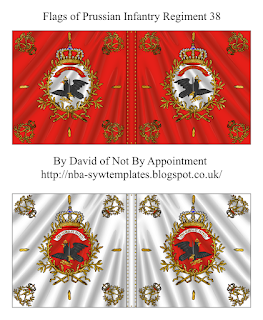

In the Seven Years War, it was with the King's Army to the surrender of the Saxons at Pirna on October 16th 1756. The companies were given an additional 30 men in January 1757. On May 6th the regiment joined the King's army at Prague. In the battle it was part of the right wing breakthrough after the massacre of the first line. The grenadiers (with IR12) suffered heavily on the left flank initial attack, losing 278 men. After Kolin the siege of Prague had to be abandoned and the regiment marched to Silesia with Bevern. After Moys and Barschdorf it was at Breslau from September and in the battle of 22nd November it was on the right wing as were its grenadiers under its chef Lieutenant General von Brandes. The position was held until nightfall and each battalion of the regiment lost about 300 men, as well as Colonel von Geiss. Breslau was evacuated on November 25th on terms of "free departure"; in the process nine-tenths of the Prussian troops deserted. The sorry remnant of the regiment returned to Berlin to be reformed. In 1758 replacements were mostly from the Mark and some of the Upper Silesians of the regiment returned after Leuthen. The grenadiers (with IR43) lost about 50% casualties at Zorndorf in August 1758 (Duffy, AFG1).

As part of the Saxon Corps the regiment advanced to Hof and Bamberg, and was part of the attempt to secure Saxony at Zschopau, Pirna and Dresden. At the end of July 1759 the regiment went with the King to Bautzen and then to Kunersdorf in August. At the battle on August 12th IR 38 was in Finck's Corps on the right wing, which opened the attack over the Trettin Heights. The regimental commander Colonel von Steinwehr was killed along with nearly 50% casualties in the regiment (Duffy, AFG1).

One battalion fought with Wunsch's Corps in Saxony, at Torgau and Korbitz, and was then captured at Maxen under Finck on November 21st 1759.

In 1760 its sole battalion was part of the garrison of Schweidnitz and captured there on October 11th. As prisoner exchange had ended it was not reformed in 1762 but after the return of prisoners in February 1763 it was reformed with the grenadier battalion of Rotkirch, formerly Köller, which had been raised from Saxon grenadiers in 1757 and served in Pomerania from 1761.

In 1784 the king complained of the regiment and its "wretched commander", who was Major General von Hager.

 And this was the uniform in 1756:


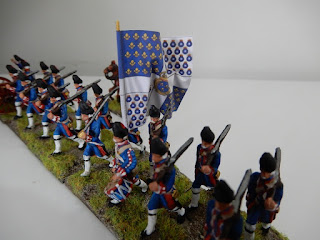
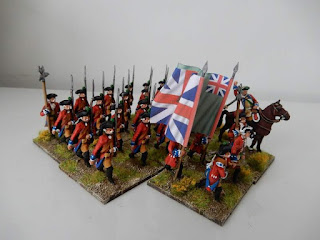
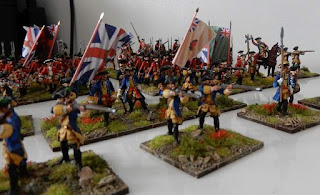
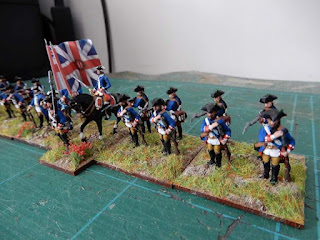
My flags "in action" - and a SYW wargame of the battle of Moys...

Willz Harley has kindly sent me more pictures of my flags with his splendid troops. He has been very busy painting lately! Here is a sample beginning with Prussian IR17:

and next Prussian IR 5:

and


Next, Prussian IR37:


A Prussian garrison regiment:


Next, Prussian IR6:

And the last of Willz's pictures for now, the French Grenadiers de France:

Konstantinos Antoniadis uses many of my French flags in his splendid and extensive 15mm army and they can be seen in many of the pictures on Flickr here:https://www.flickr.com/photos/142494696@N04/

Nigel Billington has been using my French flags and they can be seen looking good with his excellent figures on his blog here, for instance: https://nigbilpainter.blogspot.com/2022/01/28mm-syw-french-infantry-ir14-poitou.html and here: https://nigbilpainter.blogspot.com/2021/12/28mm-syw-french-infantry-ir25-limousin.html and here: https://nigbilpainter.blogspot.com/2021/11/28mm-syw-french-infantry-ir86-comte-de.html

And finally for now, I am very pleased to say that I have actually had a SYW wargame, the first in a very long time, thanks to the kindness and generosity of Jon Freitag, an American gamer. It was a remote game, using Zoom. We refought the Battle of Moys 1757 and you can find a very detailed and well illustrated account here: https://palousewargamingjournal.blogspot.com/2022/03/combat-of-moys-battle-report.html?showComment=1647032500554#c8142437012420189917

Here is a snapshot from the battle, showing my Austrian grenadiers, after a bloody fight to expel the Prussian grenadiers holding it, in possession of the Jackelsberg hill which they successfully held onto for the rest of the game:


Jon also uses my French flags and they can be seen on his blog: https://palousewargamingjournal.blogspot.com/2022/03/french-regiments-beauvoisis-and-la.html and https://palousewargamingjournal.blogspot.com/2022/02/french-regiments-provence-and-cosse.html for example.

Friday, 25 February 2022

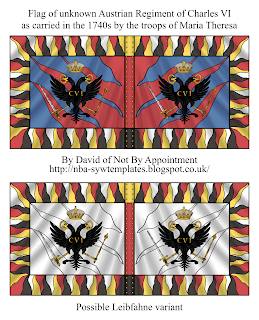
Flag of yet another unknown Austrian regiment of Charles VI, as carried in the 1740s by the army of Maria Theresa

Here's another Austrian flag from the Triomphes de Louis XV MS; how lucky we are that the French captured so many from the Austrians in the 1740s! If they had not we would know so much less...

I have added my speculative but quite plausible Leibfahne, as people seem to like having them.

I still have several left of the MS flags to recreate and they are mostly very complex flags.


Sunday, 20 February 2022

First of the Flag List Pages added - it can be found at the top of the left column on the blog

I've often been asked to list the flags available on the blog so I've just added the first Flag List Page, which lists all the French flags for wargamers to print that can be found on the blog, shown alphabetically. The link to each page can be found on the top of the left column on the blog just above the Small Donations Requested item. I shall add further pages listing the Prussian flags and others soon. I shall update the pages as I add more flags.

Sunday 20th February: I have now added a list of the Prussian flags on the blog, link in the same location atop the left hand column

Wednesday, 16 February 2022

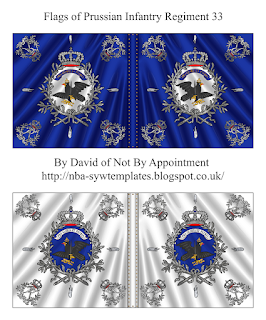
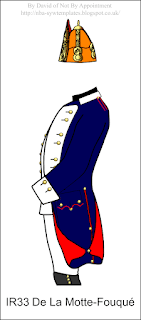
Prague Prussian Flags Project - Flags of Prussian Fusilier Infantry Regiment 33

Chef: Colonel Heinrich August, Baron de la Motte-Fouqué, later General of Infantry 31st December 1744-13th June 1774

Created June 26th 1740 from a previous garrison battalion of Magdeburg.


The regiment was with Schwerin in 1756 to the end of October. In the whole Seven Years War it experienced only two major battles. On May 6th 1757 Schwerin joined the King at Prague. IR33 was with the first attack on the left wing under Winterfeldt which was bloodily repulsed and the regiment lost its commander Colonel Balthasar Friedrich, Baron von der Goltz, and at least 50% of its numbers as casualties (Duffy, Army of Frederick the Great, 1st Edition) and a flag. It then formed part of the force besieging Prague.

The grenadier battalion (with IR42) lost up to 90% casualties at Kolin on 18th June 1757 (Duffy, Army of Frederick the Great, 1st Edition).

In 1758 it formed part of the King's army trying to encircle Olmütz and then served in Silesia under Margrave Karl, then Fouqué.

It was with the King again in 1759, at Neisse in April that year, and finally at Landeshut where, on June 23rd 1760 it fought to defend the Bober Heights against overwhelming Austrian forces under Loudon but was ultimately captured. Fouqué's corps lost 1927 dead and over 8000 wounded and captured in the fight; Fouqué himself was wounded and captured.


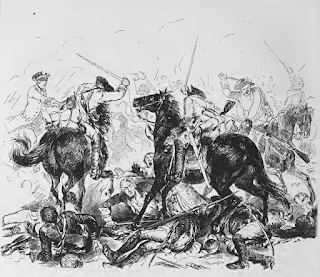
The illustration above is by Menzel from Kugler's history of Frederick and shows Fouqué's capture at Landeshut

In a famous tale of the battle, Fouqué, already wounded in the head and with sword cuts to the arm and back, was about to be struck a fatal last blow by an Austrian cavalryman but saved by the self-sacrificing actions of a groom called Trautschke who threw himself in the way of the sword blow. "Fouqué was rescued by Colonel Carl Voith von Salzburg of the Löwenstein Chevaulegers, who brought up his parade horse to have him carried away. 'He refused, saying "I would only ruin your fine saddlery." Voith replied, "no, it would gain enormously from being stained with the blood of a hero!"" (Duffy, By Force of Arms, page 238) Later, when Fouqué was taunted by a "churlish or shameless" officer for the defeat of his Corps and other Austrian officers tried to silence him, Fouqué said "Let him be. You know how it goes in war; today it's my turn, tomorrow it's yours!" (also Duffy, by Force of Arms) Zieten led the remnants of the Prussian troops to Breslau. The King was deeply shocked by the loss of his favourite Fouqué and his Corps but said that he had fought like a Roman and commended the struggle to his other generals. Fouqué was almost the last of Frederick's close confidants now that Wnterfeldt was dead. IR33 was refilled in 1763 from the former Saxon regiment of Prince Maximilian. In 1784 the King was highly critical of the regiment, although he approved of the grenadiers.

And this was the uniform in 1756:


Wednesday, 9 February 2022

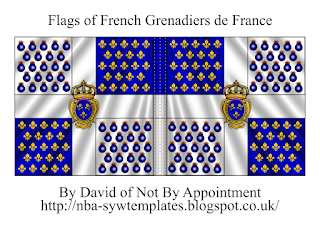
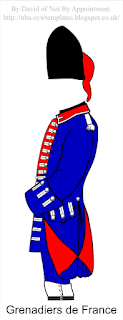
Minden French Flags Project - Flag of the Grenadiers de France

This is one I have had sitting around for quite some time and have not uploaded for some reason. I have depicted the simpler central cartouche from the 1757 MS; some illustrations show palm leaves round that cartouche. It seems there were no colonels' flags, only the Ordonnance flags; the 1757 MS illustration shows only Ordonnance flags, for instance.


At the Peace of Aix-la-Chapelle in 1748 53 French infantry battalions were disbanded but it was decided to retain their compagnies d'élite as a corps called the Grenadiers de France. Organised in 4 brigades (= battalions) of 12 companies and numbered 40th in rank, the Grenadiers de France and Grenadiers Royaux had 8 battalions at Minden: "as fierce and terrible-looking fellows as I ever saw", said one British eye witness. At Wilhelmstahl 635 were taken prisoner by the 5th Foot and tradition has it that the 5th took their bearskin caps into wear.

Having only a short existence meant that the Grenadiers de France's campaigns were all in the Seven Years War, although they were often in reserve and did not see action.

They fought at or were present at:

1757: Hastenbeck, Hanover;
1758: Krefeld, Bork, Froweiler, Münster;
1759: Minden (Todtenhausen);
1760: Homberg, Sakenhausen, Göttingen;
1761: Duderstadt (Heiligenstadt), Villingshausen;
1762: Grebenstein (Kassel), Johannisberg.

Minden was their most famous action and there they suffered severe losses, mostly from the Allied artillery fire. Much more detail of their history etc. can be found on the Kronoskaf web page and in this account (in French): http://grenadiers-de-france.e-monsite.com/pages/historique-du-corps-des-grenadiers-de-france.html

And this was the uniform in the SYW:


Tuesday, 1 February 2022

Willz Harley's Hanoverian Légion Britannique with some of my flags

The Légion Britannique was raised for service in the Hanoverian Army in 1760. It was paid for by the British government and apparently carried flags of British pattern, although its officers were Hanoverian. It consisted of 5 battalions, each of 4 infantry companies and a dragoon squadron; the strength of each battalion was intended to be 500 infantry and 101 dragoons.

As the Légion was raised from deserters, foreigners and sometimes prisoners of war, its quality can be imagined, and losses from desertion and capture were many. Despite its inauspicious make up, units of the Légion were capable of distinguished service, as with the 3rd battalion which fought well in the defence of Hamm in 1761 and the 2nd battalion which was overcome at the defence of Meppen only after a fierce resistance. French prisoners taken at Warburg in July 1760 were later enlisted in the Légion's light companies.

I created a sheet of infantry flags for the Légion based on the description in Niemeyer and Ortenburg's text on the Hanoverian Army, which states that the flags were those of British pattern, using the facings as depicted in the book as a guide to the regimental colours. Willz Harley has painted up units of the Légion and used my flags, and he gave me permission to show these pictures of his splendid troops with my flags.


Thursday, 27 January 2022

French Flags Mini-Project: Flags Carried By Infantry Regiments at St Cast 1758 Number 2: Regiment Bresse

This is another French regiment which was much busier in the early 18th century than in the SYW but fought at St Cast in 1758.

First raised 14th September 1684 from a battalion of Normandie Infantry. One battalion only and ranked 83rd at the beginning of the SYW.

These flags were carried from 1684-1762.


With the Army of Germany 1691. With the Army of the Alps 1692. At the defence of Pignerol and the battle of Marsaglia 1693. Served in Provence 1694 then embarked for Catalonia and served at the relief of Palamos.  With the Army of Italy at the siege of Valenza 1696.  With the Army of Flanders in 1697.  With the Army of Italy in 1700. At the combats of Carpi and Chiari in 1701. Then at the combat of Santa Vittoria, and battle and taking of Luzzara; combat of Stradella and Castelnuovo, taking of Nago and Arco, taking of Asti; sieges of Verceil, Ivré and Vérue, battles of Cassano and Calcinato; siege of Turin from 1702-1706.  With the Army of Dauphiné from 1707 to 1709.  With the Army of Flanders, combat of Beuvrage, battle of Denain, siege of Douai from 1710-1712. In garrison at Douai.

 With the Army of Bavaria in 1742, combat of Sahay, relief of Frawemberg, defence of and retreat from Prague.  With the Army of Flanders in 1744.  With the Army of the Lower Rhine in 1745.  With the Army of Flanders, sieges of Mons, Charleroi and Namur, battle of Rocoux in 1746. Defence of Provence in 1747. Defence of the Gênes River line in 1748.
 
 Campaign of 1756 on the coast of Normandy. Campaigns of 1757 and 1758 on the coast of Brittany, combat of St Cast. Campaigns of 1759 to 1762 on the coast of Aunis. Disbanded 25th November 1762.

And this was the uniform in 1756:


Tuesday, 25 January 2022

French Flags Mini-Project: Flags Carried By Infantry Regiments at St Cast 1758 Number 1: Regiment Brie

As with the Prussian infantry flags, I hope and plan to do all the French infantry flags eventually. The British landing at St Cast in 1758, where the French gave British forces a very bloody nose, caught my attention recently so I have decided to do the remaining French infantry flags from this action. (I have already posted the flags of French infantry regiments Royal des Vaisseaux and Penthièvre which also fought at St Cast.) I shall list the earlier actions and campaigns of these regiments as well as their SYW experiences as they mostly had much more to do in the War of the Spanish Succession and War of the Austrian Succession and sometimes earlier, so these flags will appeal to wargamers depicting earlier French armies.

Brie ranked 87th at the beginning of the SYW and was only one battalion strong.

The flags as shown were carried from 1684-1762.


Brie first raised September 1684 from companies of the regiment of Picardy. In garrison in Calais 1687. Conquest of the Palatinate 1688. Served on the Rhine to 1693. With the Army of Italy from 1694-1696. With the Army of the Meuse in 1697. With the Army of the Rhine at the battle of Friedlingen 1702. At the sieges of Brisach and Landau and the battle of Speyerbach 1703. With the Army of the Alps 1704. At the conquest of Nice 1705. At the siege and battle of Turin 1706. At the defence of Toulon 1707. With the Army of the Rhine from 1708 to 1713. Briefly renamed Comte de la Marche 1726-1727.

With the Army of the Rhine 1733. At the siege of Philipsbourg 1734. At the combat of Klausen in 1735.

With the Army of Bavaria at the relief of Braunau 1742. At the defence of Eggenfeld 1743. Returned to the Rhine and at the battle of Rheinweiler. With the Army of the Alps in 1744; its colonel was severely wounded at the taking of Chateau-Dauphin. At the defence of Asti, where the regiment was taken prisoner, 4th March 1746. Exchanged in June 1747 and reformed on the Seyne, and then moved to Gênes where it served until the peace.

Defended the coast of Brittany during the Seven Years War. At the combat of St Cast in 1758; there its colonel was mortally wounded. Disbanded on the 25th November 1762.

And this was the uniform in 1756, as far as I can tell; there may have been a red collar earlier than 1758, when the État Militaire says it had one.


Monday, 24 January 2022

Prague Prussian Flags Project - Flags of Prussian Infantry Regiment 32

Chefs: Major General Joachim Christian von Tresckow, later Lieutenant General, 17th May 1747 to 25th June 1763

Newly raised in 1743, originally as fusiliers, from a garrison battalion and companies.


In 1756 the regiment was with Field Marshal Schwerin's Corps, taking part in the limited fortress attacks along the southern border of Silesia from mid-September to the end of October. In 1757 this Corps went to join the King's Army, which it met on May 6th at Prosek. At the battle of Prague the regiment was part of Hautcharmoy's second attack after the failure of the first line; after breaking through the enemy centre Tresckow took command after Hautcharmoy fell. There was murderous fighting in the Rokenitz Brook and Christopher Duffy, Army of Frederick the Great, 1st Edition, shows IR32 with about 25% casualties. As part of the forces investing Prague after the battle IR32 missed Kolin. After that, with the Duke of Bevern's Corps the regiment suffered badly and behaved ill at Moys on September 7th (as General von Winterfeldt was shot in the back here it is possible, as suggested by Christopher Duffy, that he was shot by his own men, perhaps from this regiment raised largely from understandably disaffected Upper Silesian Catholics!). The regiment then marched to Breslau, leaving that city on November 25th with just one battalion.

With the King's Army in 1758 it was at Domstadtl on June 30th, while the grenadiers under Tresckow had captured the fortress of Schweidnitz by April 16th.

In 1759 it was with the Pomeranian Corps and fought at the bloody defeat of Kay; its commander, Colonel Burkhard von Jagow, was killed there. With only one battalion left it was given the task of securing the Oder crossings to Kunersdorf at Göritz from 11th August. In mid-September the battalion, now under Finck, reached Wunsch's Corps at Torgau. On September 21st it took part in the victory of Korbitz.

In 1760 and 1761, restored to two battalions again, it was part of the garrison of Schweidnitz, its place in the field army taken by garrison regiments. On October 1st 1761 it was captured by Loudon's forces; the troops under the command of von Zastrow had been left by the King with far too few men for the task of holding the fortress.

The regiment was not restored in 1762 and was replaced in 1763 by von Horn's regiment, which had been in Saxony under Prince Friedrich August. In 1784 the King complained: "It doesn't amount to much."

Christopher Duffy says in the Army of Frederick the Great: "First battalion distinguished at Domstadtl but the regiment as a whole performed badly at Moys and Kay, due to the large element of Upper Silesian Catholics. Captured at Schweidnitz 1761 and replaced by the regiment of Horn (formerly no. 56)."

 And this was the uniform in 1756:


Tuesday, 11 January 2022

Flags of yet another unknown Austrian regiment of Charles VI, as probably carried in the 1740s by the army of Maria Theresa

This is another flag which I have recreated from the flag as depicted in the Triomphes de Louis XV, the contemporary source showing flags captured by the French armies in the 1740s. The flag at the top is as depicted in the Triomphes, which seems rather unfinished to me, with the large gap above the eagle making the composition seem very unbalanced. So I have added an Austrian crown and ribbons above the eagle in the second flag down, as well as in the possible Leibfahne design at the bottom.


Saturday, 1 January 2022

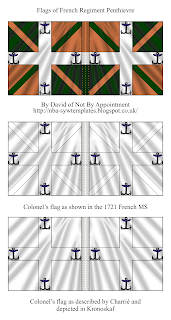
Flags of French Regiment Penthièvre

For this, my first flag posting of 2022, I have returned to my beloved French flags. A chap with a blog who is raising 14 regiments of French infantry (see: https://prometheusinaspic.blogspot.com/2021/12/wss-first-french-unit.html#comment-form) for the WSS, and using my flags, lacked only these flags so I said I'd do them. Luckily for me the accompanying text is fairly short, so an easy way of easing myself into the flags for a new year!

A Happy New Year to everyone.

This regiment was first raised 1684 for the Comte de Toulouse and known as Toulouse Infantry. Became Penthièvre Infantry on the death of the Comte de Toulouse in 1737 in honour of his son the Duc de Penthièvre.

2 battalions Ranked 67th in 1756.

The flags were the same from 1737-1791; but the flags carried by Toulouse Infantry were almost identical. Charrié says the Toulouse flags had aurore rather than feuille morte but I think the difference is notional.


Susane Volume 7 (my translation): In 1754 the regiment took part in the camp of Aimeries sur Sambre and at the beginning of the war was sent to Brittany, where the Duke of Penthièvre was in command. During the whole of the war the regiment defended the coast of Brittany against threatened attacks by the British, and was very distinguished in the battle of Saint Cast, where the British troops, completely beaten, were obliged to re-embark with haste under the fire of our artillery. Major de Vangelas, appointed lieutenant colonel in 1762, and Captain Mons were wounded in that fight. At the peace Penthièvre was sent to La Rochelle and the islands of l'Aunis.

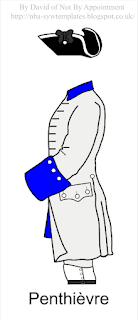
And this was the uniform in 1756:


Monday, 27 December 2021

Some Seasonal Silliness: The guidon of Santa's Own Light Cavalry

 This is a British-style light cavalry guidon for Santa's Own Light Cavalry:


And I added a British heavy cavalry-style standard of Santa's Heavies to my long-neglected Tippelbruder blog here: http://freistadttippelbruder.blogspot.com/2021/12/one-more-bit-of-seasonal-silliness.html

Saturday, 25 December 2021

Prague Prussian Flags Project - Flags of Prussian Fusilier Infantry Regiment 40

The garishly pink flags of IR40 seem suitably festive for my Christmas posting. I wish everyone a Happy Xmas and New Year. More to come soon including more of the Austrian WAS flags.

Chefs: 1st May 1750 Colonel Johann Friedrich von Kreytzen, brother of the previous chef, later Lieutenant General; 7th April 1759 Major General Georg Carl Gottlieb von der Gabelentz, later Lieutenant General, to 1777

Regiment given to Prussia in 1740 by Duke Wilhelm Heinrich of Saxe-Eisenach, who was its first chef to his death in 1741.


 It was with the Corps of Field Marshal Count von Schwerin in 1756. In April it marched to Bunzlau as part of General von Puttkamer's Advance Guard and took the magazine there on April 26th. On May 6th it was part of the failed left wing attack at Prague, but had fewer than 20% casualties (Christopher Duffy, Army of Frederick the Great, 1st Edition, henceforth AFG1). In the battle of Kolin on 18th June it struggled towards Brzezan under heavy artillery fire and near the end of the battle was attacked by the Austrian cavalry, as was the First Guard Battalion alongside which it was fighting. Around 6pm it was at Planjan helping to keep the escape route to Nimburg open for the routed Prussian army. Losses were at least 30% (AFG1). At Schweidnitz under the command of Grumbkow it launched an attack that took 400 prisoners but after the loss of several forts to the enemy the regiment was captured on November 12th. Its chef Colonel von der Gabelentz refused to sign the capitulation. While it was on its way to captivity in Brünn the grenadiers were fighting on the right wing at Leuthen (with those of IR33).

The regiment was returned in 1758 and reorganised at Landeshut by July and then sent to join Dohna's Corps at Frankfurt on 31st July, moving to west of Küstrin on August 17th. At Zorndorf on August 25th both battalions were on Dohna's Wing, the second battalion covered the greta battery on the right wing, where it was attacked by Russian cavalry on the flank. Surrounded and having lost two flags it was saved by the counter attack under Seydlitz and Schorlemmer. The King was "highly satisfied" with its performance. The grenadiers were captured on the left wing at Hochkirch, and at the same time the musketeer battalions marched to the Mulde and fought at Torgau and Eilenberg in November.

With the Pomeranian Corps in 1759 the regiment suffered heavy losses at Kay in repeated attacks on the Palzig Heights, so much so that at Kunersdorf on August 11th-12th it was used to guard the Oder bridges at Görtz. By the end of September it was in Saxony again.

In 1760 it was part of the failed siege of Dresden and then in Silesia it served on the left wing at Liegnitz on August 15th.

In 1761 the regiment was part of the advance towards Poland and was camped with the King at Bunzelwitz.

In 1762 it was in action at the recapture of Schweidnitz from August 8th to October 10th.

In 1784 the King said that the men hardly resembled soldiers and was even ruder about the regiment in 1785.

And this was the uniform in 1756:


Sunday, 12 December 2021

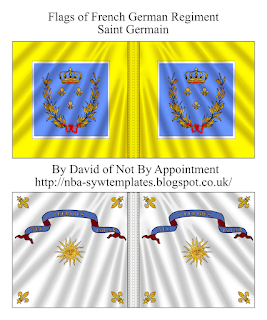
Rossbach French Flags Project - Flags of French German Regiment Saint Germain

First raised 1st July 1747. Colonel Le Comte de Saint-Germain.

One  battalion. Rank 114th in the SYW.

This was a short-lived German regiment which does not seem to have especially distinguished itself in the 13 years of its existence. Apart from the Kronoskaf account, I have found little detailed information on its history. Still, the flags are attractive ones. (I have taken some of the detail from the 1757 MS e.g. the white border to the central device on the Ordonnance flag.)


1748 Flanders: Siege of Maastricht

1755 On the coast of Flanders

1756 In the Camp at Dunkirk

1757 Germany with the Army of the Lower Rhine under Maréchal d'Estrées. At Hastenbeck on July 26th.  Eventually transferred to the army of Soubise and was at Rossbach 5th November 1757. (Christopher Duffy's detailed account of the battle makes no mention of the regiment suggesting its performance there was less than spectacular.)

1758 the regiment was with Clermont's army in Germany but was then transferred to Soubise's army by July. In October it was at the battle of Lutterberg in the centre of the first line. According to Kronoskaf, on 1st December the regiment pulled off a coup when it captured the town of St Goar, some troops having scaled the walls to take it and capturing 50 prisoners. It then went on to summon and take the castle of Rheinfels, making its 700 strong garrison prisoners.

1759 In April it was at the battle of Bergen, supporting the artillery. With the main French army under the Marquis de Contades in western Germany, it fought at Minden on 1st August under its colonel the Comte de St Germain. It and other regiments of the Anhalt Brigade covered the retreat of the French army.

Incorporated in Nassau Infantry in January 1760 as its third battalion.

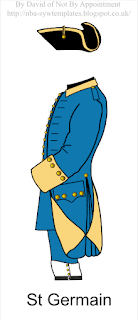
I have taken the uniform details from the 1757 MS which shows the coat unlaced. Here is the uniform in 1756:


Friday, 10 December 2021

Prague Prussian Flags Project - Flags of Prussian Infantry Regiment 17 von Manteuffel

First raised 1693.

Chef:  from 20th July 1756 Major General Gerd Heinrich von Manteuffel, later Lieutenant General, to 1764


The regiment fought at Lobositz October 2nd 1756 with the King's Army, exchanging fire with the Croats on the Lobosch Hill for five hours until it ran out of ammunition. The Austrians counter-attacked around 1pm and the regiment responded with clubbed muskets and bayonets. Welhotta was captured and nine fresh Austrian battalions driven back into Lobositz itself. Regimental losses were heavy; Christopher Duffy, Army of Frederick the Great, 1st Edition, henceforth AFG1, shows about 25% casualties.

At Prague on May 6th 1757 the regiment was on the right wing between the Hlaupetin Ridge and the ravine of the Rokenitz Brook. AFG1 reports that: "Warnery says of these grenadiers [those of IR 17 and IR22's combined battalion] at Prague that they were "the only ones who did not open fire but pressed home the attack at bayonet point! After all they were Pomeranians ... who are beyond doubt the best infantry in the world"." At the battle of Kolin 18th June the regiment was ordered to march to the left, after the army broke through on the Krzeczhorz Heights, to maintain control of the area but the command did not reach them. The regiment stood fast for 30 minutes at Chozenitz along with IR 20 under General von Manstein, swept by artillery fire and musketry, where it helped to protect the retreat of the beaten left wing of the army. Kolin AFG1 shows at least 30% casualties. The regiment then fought at Moys on 7th September where General von Winterfeldt was killed, possibly shot in the back by his own troops, some of whom were Saxons forcibly enlisted after Pirna. On November 22nd the regiment was caught up in the defeat at Breslau. At Leuthen (and also Rossbach and Zorndorf later) only the grenadier battalion was present; AFG1 shows 25% casualties at Leuthen and 50% at Zorndorf.

On March 15th 1760 the regiment was highly distinguished in a fight against very heavy odds. Under Lieutenant General Baron von der Goltz the regiment was escorting a convoy from Neustadt to Steinau and was attacked by the Austrian General Loudon who had 3000 cavalry, 2000 Croats and 1900 grenadiers. Twice the regiment refused a demand to surrender. Von der Goltz reported that "they commenced to hack at us six times but did not succeed once". The Prussians reportedly lost only 35 dead, 43 captured and 79 wounded, and claimed to have killed or wounded 800 of the Austrian attackers. The King gave six Pour-le-merite medals in thanks and wrote "I hope that other generals take a good example from this action, for this is the old Prussian way of defending oneself successfully even against vast enemy superiority. Convey my compliments to the officers of Manteuffel in my name. They have acted in our old, honourable way, and not according to the  infamous modern example of other folk". Loudon said there were no Prussian deserters "because the regiment consists of native-born Pomeranians". At Torgau on November 3rd of the same year the regiment was part of the second main attack under General von Bülow against the Zinna Heights and captured four cannon but suffered 1000 casualties, half its numbers.

In 1761 the regiment was with Prince Heinrich in Saxony. At Freiberg on October 29th 1762 it fought under Major General von Alt-Stutterheim against the enemy right wing, and pushed it back to the south along the Spittelwald by clever use of the terrain, reportedly.

Christopher Duffy says: "A good Pomeranian regiment, distinguished at Soor, Prague and Neustadt 15 March 1760."

And this was the uniform in 1756:


Wednesday, 1 December 2021

Flags of yet another unknown Austrian regiment of Charles VI, as probably carried in the 1740s by the army of Maria Theresa

The top flag is taken from the contemporary source showing Austrian flags as carried in the 1740s. The bottom two are hypothetical but quite possible Leibfahnen. Many Leibfahnen carried in the War of the Spanish Succession simply had the same pattern as the Ordinair-fahnen but with the main background colour of the flag as white. However, some also carried a small image of the Virgin and Child in a cartouche in the centre, as I have shown here in the final flag.


Sunday, 28 November 2021

Rossbach French Flags Project - Flags of French German Regiment La Marck

First raised 1680. Ranked 66th in the Seven Years War. 2 battalions.


 This pattern of flags was carried from 1697-1791.

Text from Susane Volume 7 translated by me:

In 1756 La Marck was part of the auxiliary corps promised by Louis XV to the Empress [Maria Theresa] but France having had to take part on its own account in the Seven Years War, the regiment was called to the army of Marshal d'Estrées and was present at the battle of Hastenbeck. The volunteers, commanded by Captain de Nézot, found themselves attacking the rearguard of the enemy at Bielefeld and suffered greatly from the fire of the enemy artillery. The regiment then followed Marshal de Richelieu who came to replace the Marshal d'Estrées in Hanover. After the Convention of Closterseven the regiment was at the camp of Halberstadt which it left on the 7th October, to go to reinforce the army of the Prince de Soubise. It was crushed on the 5th November at Rossbach [the next part of the sentence does not seem to make much sense so I have omitted it]. Captains Mantz l'ainé and Limar, and lieutenants Hiem, Brancion, Druhot, Suty and Beurdhal lost their lives; captains d'Ayrolles, Trichard, Desbarreaux, Lescalier, Housseau, Grandchamp, d'Eblingheim, Mantz cadet, Desfossé-Solis, Dufort and Lyautey were wounded, as were the three aide-majors Carlier, Maës and Scheid, and seven lieutenants amongst whom were Monsieurs Montel and Baklau.

The remnants of the regiment retreated to the Rhine and when Prince Ferdinand had crossed the river at the beginning of 1758, they were ordered to throw themselves into Dusseldorf. La Marck found itself that year at the battle of Krefeld and the combat of Meer, where it took from the enemy a cannon which replaced the one it had lost at Rossbach.

La Marck does not seem to have been actively employed in 1759. On the 18th January 1760 it incorporated the 2nd battalion of the regiment of Lowendhal, which raised its strength to three battalions. On the 10th of July it was distinguished at the battle of Corbach and, at the end of the same month, it made a vigorous contribution to the attack on Cassel and on the camp of Sachsenhausen, which Prince Ferdinand was obliged to abandon. The same year Captain de Nézot, who had continued to distinguish himself at the head of a company of volunteer chasseurs, played a brilliant part in the taking of Minden and received the cross of Saint-Louis at the age of 23 years. During the winter La Marck took part in the attack on the lower town of Statsberg and in 1761 the battle of Wilhemstadt and all those actions which took place around Cassel. A regulation of 21st December 1762 reduced the regiment to two battalions.

After the end of hostilities, La Marck was sent into garrison at Thionville.

 And this was the uniform in  1756:


Saturday, 20 November 2021

The flags of the French Volontaires de Hainaut, formerly those of the Arquebusiers de Grassin

I return briefly to my beloved French flags. Kronoskaf and the website Nec Pluribus Impar say that the Volontaires de Hainaut carried the flags of the Arquebusiers de Grassin, which I cannot find confirmed anywhere else, but as the thought pleases me I shall go along with it, as it means the flags can be used both in the WAS and SYW.


The Arquebusiers de Grassin were first raised January 1744. At first they consisted of 1300 men in total, including 900 fusiliers in nine companies, 100 grenadiers in two companies and 300 cavalry in six companies. An additional 200 cavalry were raised in 1745 but in 1748 they were progressively reduced to a total of only 340 men by December that year. In August 1749 they were incorporated into the Volontaires de Flandres.

Their somewhat exotic uniform is well known.

They saw much action in the War of Austrian Succession. At Fontenoy in May 1745 they were thrown into the Wood of Bary. At the battle of Rocoux along with the Fusiliers de la Morlière (with whom they often fought) they spearheaded the attack on the village of Hans, contributing to the withdrawal of the enemy left wing followed by the retreat of much of the rest of the enemy army. They were opposed by Pandours and Croats during much of the action. At the end of the action they attacked the Dutch artillery which withdrew, although the Grassins captured 22 guns and more than 60 artillery carts with teams. They also attacked and attempted to destroy bridges over the Meuse which the enemy was using in its retreat. At the battle of Lauffeld they were similarly employed on the right of the army but overthrown by the British cavalry. They were also at the siege of Huy in August 1746.

The Volontaires de Hainaut were raised in April 1757 by splitting the Volontaires de Flandres in two. The unit consisted of six companies of 70 men each, including 30 dragoons. In February 1758 it consisted of eight companies of 75 men each - 40 fusiliers and 35 dragoons. The unit became the Legion de Hainaut in December 1762, the Legion de Lorraine in 1768 and was disbanded in 1776.

The Osprey on the light troops of Louis XV has a useful summary of the unit's activities in the Seven Years War (and Kronoskaf has a more detailed account). The Volontaires de Hainaut saw much action in the Seven Years War. They first saw action at the battle of Hastenbeck in 1757, then took part in the surprise attack on Harbourg, where they captured hundreds of enemy soldiers and several flags but the unit was captured after the surrender of the garrison of Minden in March 1758, following a stubborn resistance. It was re-raised by a new commander, Thomas-Auguste de Grandmaison, who was the author of La Petite Guerre, a treatise on partisan and light troop warfare. Having been sent to Germany the unit fought at Bork, Minden, Mardorf, Nordecken and Laughaus in 1758, rescued Bercheny's hussars in a fight in July 1760 and then captured Minden in August. Its most famous feat was its capture of the infantry of G'shray's Prussian Frei Korps at Nordhausen in August 1761.

And this is the fusilier uniform in 1757:

And these were the later SYW flags of the Volontaires de Hainaut:


Wednesday, 17 November 2021

Prague Prussian Flags Project - Flags of Prussian Infantry Regiment 29 von Schultze

Chefs: from 17th April 1747 Major General Hans Caspar Ernst von Schultze, later Lieutenant General, died 2nd December 1757 of wounds received at Breslau; from 5th January 1758 (to 1764) Major General Carl Gottfried von Knobloch, later Commandant of Schweidnitz


In 1756 IR29 was with Schwerin's 2nd Silesian Corps which withdrew on October. In April 1757 IR29 marched to join the King's Army. At Prague on May 6th, after the failure of Winterfeldt's attack, it was with Hautcharmoy's Division leading the breakthrough south of Kej but at the Rokenitz Brook suffered heavy casualties ((Duffy, Army of Frederick the Great, 1st Edition, henceforth AFG1, shows at least 25% casualties) until saved by the advance of Schwerin's wing of the army. At Kolin on 18th June it was given the task of taking the Krzeczhorz Heights on the left flank with the advance guard under Major General von Hülsen. After repeated attacks which appeared to have succeeded by 5.30pm, Austrian counter-attacks completely overcame the Prussians who were defeated with heavy losses on the entire battlefield.  (AFG1 shows at least 40% casualties in IR29.)

With Bevern in August the regiment took up a fortified position on the River Lohe at Breslau, and in the defeat on 22nd November Lieutenant General von Schultze was mortally wounded. Breslau then surrendered to the Austrians. IR29 was reduced to only one-tenth of its numbers and the remainder retired to Berlin to be reformed.

In 1758 IR29 joined Prince Heinrich's Saxon Corps, whose task was to protect Saxony against much superior enemy forces. Major General C. H. von Wedell was its chef for only three months until transferred to IR26. At Hochkirch on October 14th the regiment lost at least 75% casualties (AFG1).

In the spring of 1759 the regiment was part of the advance into Franconia but then fought at Kunersdorf on August 21st and suffered heavy losses in the infantry fight on the Kuhgrund (AFG1 shows at least 45% casualties). One battalion was taken prisoner at Maxen on November 21st. The remaining battalion occupied Breslau in 1760 and the grenadiers fought at Liegnitz and Torgau (losses at Liegnitz were at least 20% (AFG1); the grenadiers of IR29 were combined with those of IR31).

Having been recruited up to full strength again IR29 joined the Goltz Corps in 1761 and experienced the advance through Gostin and Krölin and the subsequent breakthrough across the Spie Brook to the Württemberg Corps on October 2nd. But the regiment was then surrendered by its chef von Knobloch at Treptow on October 25th.

In 1762 it was in garrison in Breslau, and then both the regiment and the grenadiers took part in the siege of Schweidnitz from August 8th to October 10th; possession of Schweidnitz was crucial in deciding the ultimate control of Silesia by the Prussians at the end of the war.

Christopher Duffy (Army of Frederick the Great, 1st Edition) says: "Badly mauled at Kolin, Hochkirch and Kunersdorf. One battalion lost at Maxen". Of its grenadiers, he says: "Distinguished at Liegnitz. Suffered heavily at Kunersdorf and Torgau". Despite its unlucky record in the SYW, the regiment was in favour with Frederick after the war.

And this was the uniform in 1756:


Wednesday, 10 November 2021

Prague Prussian Flags Project - Flags of Prussian Infantry Regiment 12 Erbprinz von Hessen-Darmstadt

Chefs: From 15th December 1743 Oberst Ludwig IX, Erbprinz von Hessen-Darmstadt, later Lieutenant-General; from 10th November 1757 Generalmajor Friedrich August von Finck, later  Lieutenant-General; from 29th May 1763 Generalmajor Johann von Wunsch, later General of Infantry.


In 1756 the regiment had already been mobilised on 26th June as part of the III Corps. It moved to Lusatia in December and was then at the battle of Prague on 6th May 1757, where it was on the right wing in the first line and under Colonel von Hertzberg led the breakthrough south of Kej "at a run over the long dam at Hostawitz". (Duffy, Army of Frederick the Great, 1st Edition, henceforth AFG1, shows the grenadier battalion as having lost about 25% casualties.) It missed Kolin. The regiment was considered well-trained by its chef Hereditary Prince Ludwig von Hessen-Darmstadt.

In 1758 the regiment was part of Prince Heinrich's Saxon Corps, intended to keep the Imperial army occupied and away from the Royal army. From the end of June it was stationed at Zschopau, Pirna, and Dresden, and then in mid-October was transferred to the corps of Major General von Finck, west of the Elbe. Its grenadiers fought at Hochkirch.

It was still in Saxony in 1759 and took part in the second advance to Franconia and then with the rest of Finck's Corps joined the King's army at Lebus by 9th August. At Kunersdorf on 12th August it was involved in the opening manouevres then the attack on the Trettiner Heights (AFG1 shows about 70% casualties). The grenadiers were at Liegnitz on 15th August and lost about 45% casualties (AFG1). On 20th November the entire regiment was captured at Maxen. Wunsch had wanted to fight his way out but was forbidden.

Reformed in 1760, one battalion of the regiment served with Prince Heinrich's Corps, which advanced to the River Warta to oppose the Russians; then it was in von der Goltz's Corps. After that in 1761 two battalions served with Zieten, then with Platen at Gopstyn in September and at Spie near Kolberg in October. Finally it was in Pomerania to the end of the year.

With the King's army in Silesia, on the 21st July the regiment stormed the southern redoubt at Ober-Leutmannsdorf with the bayonet, fighting up a slope with no cover. The King gave two Pour-le-merites to its officers as a reward.

Christopher Duffy (AFG1) says: "Broken at Prague, shot up at Kunersdorf, ridden down and captured at Maxen. Surprised at Cammerswalde 7 February 1779. Brave but unfortunate." It was well regarded by the King after the war.

And this was the uniform in 1756:


Sunday, 7 November 2021

Flag of yet another unknown Austrian regiment of Charles VI, as probably carried in the 1740s by the army of Maria Theresa

This Charles VI flag shows that the older War of the Spanish Succession-style square flags were still being carried in the 1740s.

I have also posted a possible Leibfahne, following the pattern of many of the Charles VI period flags.


Saturday, 23 October 2021

Flag of yet another unknown Austrian regiment of Charles VI, as probably carried in the 1740s by the army of Maria Theresa

This is the simplest of the Charles VI Austrian flags from the 1740s, as represented in my contemporary source, with no elaborate border. Well, it adds to the variety! There is a total of 16 probable Austrian flags in that source but I think 3 of those are (near) duplicates of 3 others, so the total is really only 13.


I've been asked to produce another hypothetrical Leibfahne so here it is:


Thursday, 21 October 2021

Prague Prussian Flags Project - Flags of Prussian Infantry Regiment 28 Hautcharmoy

Chefs: from 1742 Colonel Heinrich Carl Ludwig Herault de Hautcharmoy, later Lieutenant General, who died 16th May 1757 of wounds received at Prague 6th May; from 5th January 1758 Major General Lorenz Ernst von Münchow, who died January 1758 of wounds received at Leuthen 5th December 1757; From 4th April 1758 Major General Johann Friedrich von Kreytzen; From 20th May 1759 Major General Friedrich Ehrentreich von Ramin, transferred to IR25; From 8th February 1760 Major General Friedrich Wilhelm von Thile (to 1770).

In 1756 the regiment was part of Schwerin's Silesian Corps, which protected the County of Glatz from enemy forces from mid-September to the end of October while the Bohemian offensive took place. Transferring to the King's army in mid-April, it took part in the battle of Prague on May 6th. As part of Hautcharmoy's force on the right wing  it led the breakthrough south of Kej. Casualties were heavy (Duffy, Army of Frederick the Great, 1st Edition shows about 40% casualties). Its chef Hautcharmoy was mortally wounded.

The grenadiers were in the defeat at Landeshut on August 14th and the musketeer battalions were captured by the Austrians on November 12th during the first siege of Schweidnitz. On April 16th 1758 the grenadiers took part in the storming of the city, taking the Galgen Fort, and the regiment was raised again from the more than 12,000 Prussian troops returned as part of a prisoner exchange. Silesia had also once more begun to send replacements after the battle of Leuthen,

In May IR 28 marched with the King's Army to besiege Olmütz. It suffered many casualties while guarding the train of 4000 waggons when it was attacked at Domstadtl in early May. Under Margrave Carl it went back to Silesia at the end of October.

In 1759 it was part of the King's camp at Schmottseiffen and fought at Konradswalde near Landeshut. On June 23rd 1760 the grenadiers were beaten at Landeshut. The rest of the regiment fought on the Warthe in Prince Heinrich's Corps.

In 1761 the regiment was in the King's camp at Bunzelwitz. The grenadiers were sent to Pomerania with Platen and suffered heavy casualties in the battles of Körlin, Spie and Kolberg..

In the winter of 1761-2 the regiment was reorganised and saw no more action in 1762 in Silesia. The grenadiers, with Bevern, fought at Reichenbach on August 16th.

Despite its few successes, the King, in his usual capricious fashion, favoured the regiment after the Seven Years War. But he claimed in 1784 that the  regiment was in such disorder that he needed to send officers from his own regiment to reorganise it.

And this was the uniform in 1756: